A book of proofs, figures and invocations.
The Codex is the speculative half of the research. Where Volume I surveys the Earth’s systems and the tools for modelling them, Volume II asks what form is, and answers in the language of operators, fields and harmonics.
It should be read for what it is. The mathematics is real mathematics, Banach’s fixed-point theorem, spherical harmonics, the Schrödinger equation, used partly as demonstration and partly as analogy. The book also contains myth, theology and poetry, and it says so. Its preface advises readers who are not mathematicians to ask of each formula one question: "What relationship does this show?"II, p. 14
This page summarises the argument in the book’s own terms and keeps its figure captions. Claims about the planet in this volume are philosophical and mathematical proposals; they are not presented here as measured science.
| Thesis | Statement | Pages |
|---|---|---|
| T.1 | Reality is the fixed point of a chain of non-violent contraction operators. | 19–25, 201–206 |
| T.2 | Emptiness is generative: "the loom on which reality is woven." | 71–73 |
| T.3 | Consciousness is an operator; perception is a change of basis that co-authors what is seen. | 49–52 |
| T.4 | The Earth is a spherical standing-wave system with nodal sites. | 77–80 |
| T.5 | Architecture is a contraction operator that crystallises planetary harmonics into form. | 137–143 |
| T.6 | Form is organised energy. | 117 |
| T.7 | In practice: tuning, not command. AURA and the Codex Swarm. | 161–165, 195–198 |
Not command. Not domination. Not optimization. But tuning.
Vol. II: The Codex, p. 195
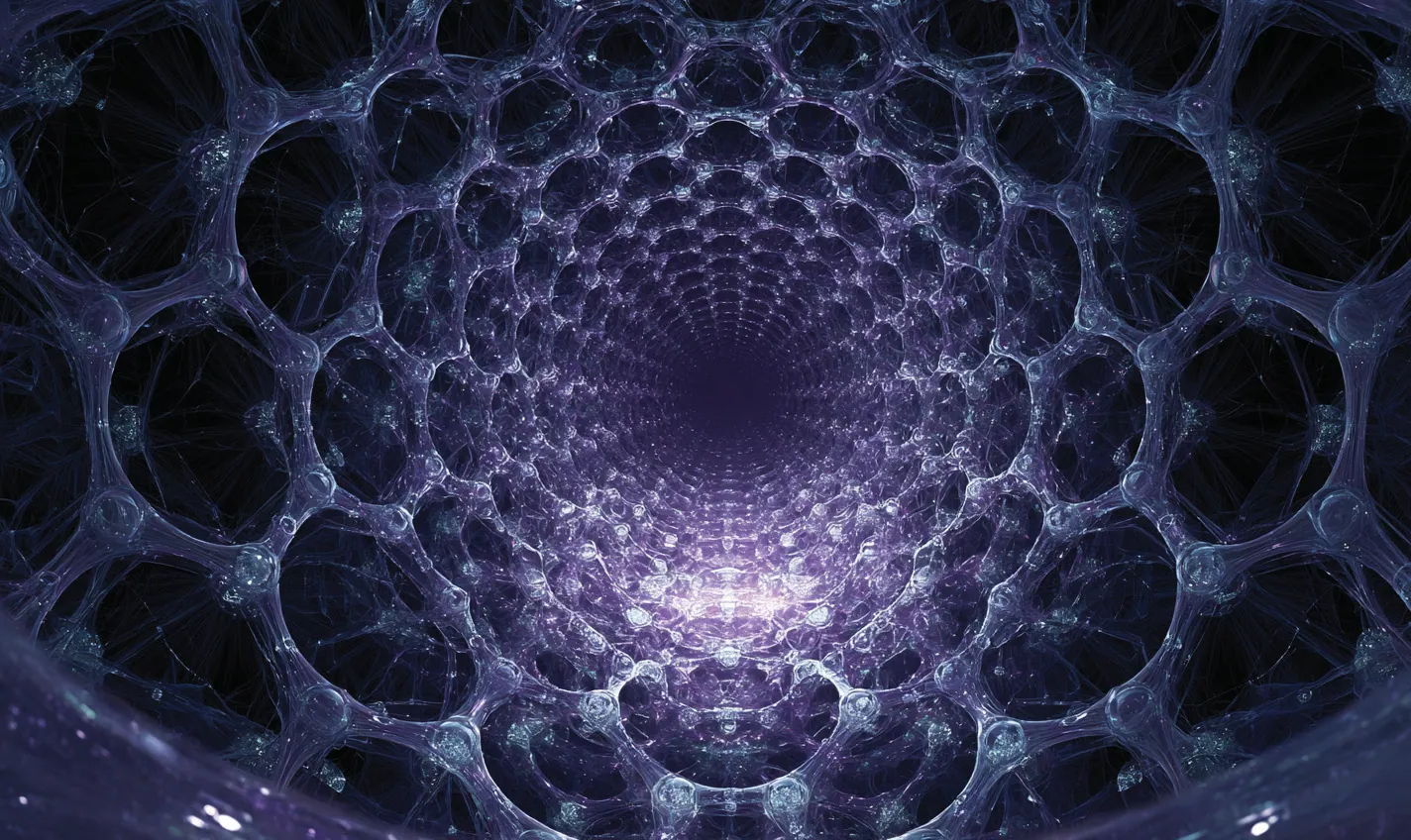
The lattice.
Fig. 1 · Armada Configuration
Vol. II: The Codex, p. 20
Twenty-five chapters.
M marks a mathematical chapter, P a philosophical or spiritual one, A an architectural or applied one. Page numbers are those of the printed book.
| Ch. | Title | Kind | Argument | pp. |
|---|---|---|---|---|
| — | Foreword | Samuel Lee, MD | Presents the book as transmission and as "a sacred text disguised as architecture". Advises reading slowly and letting the images arrive before the words. | 7–9 |
| — | Preface | Marcela Oliva | Cities are living systems. Ascension means alignment, not escape. The formulae are structural correspondences. Closes with a guide for non-technical readers. | 11–14 |
| — | Prologue | A myth of origin: the atomic bomb as a signal, and a harmonic lattice drawing close around the Earth "like hands around a fragile flame". | 17 | |
| 01 | Status of the Invisible World: The Pacific Siege Equilibrium | M · P | A fixed-point argument built from a chain of contraction operators. Introduces the "Paradiso condition": stability without coercion. | 18–30 |
| 02 | Multi-dimensional Vector Field Armada | M | Six contraction lemmas and stereographic stabilisation. Corollary: parametric fractal architectures are "materialized frequency". | 32–42 |
| 03 | A Hieroglyphic Codex on the Siege of Light | P | The nuclear threshold retold as a mythic event; the preceding proofs recast as a physics of guardianship. | 44–46 |
| 04 | The Interplay of Tensor Matrices and Consciousness in the Structure of Reality | M · P | Perception as a change of basis. Consciousness and structure share a fixed point: "tensorial monism". | 48–52 |
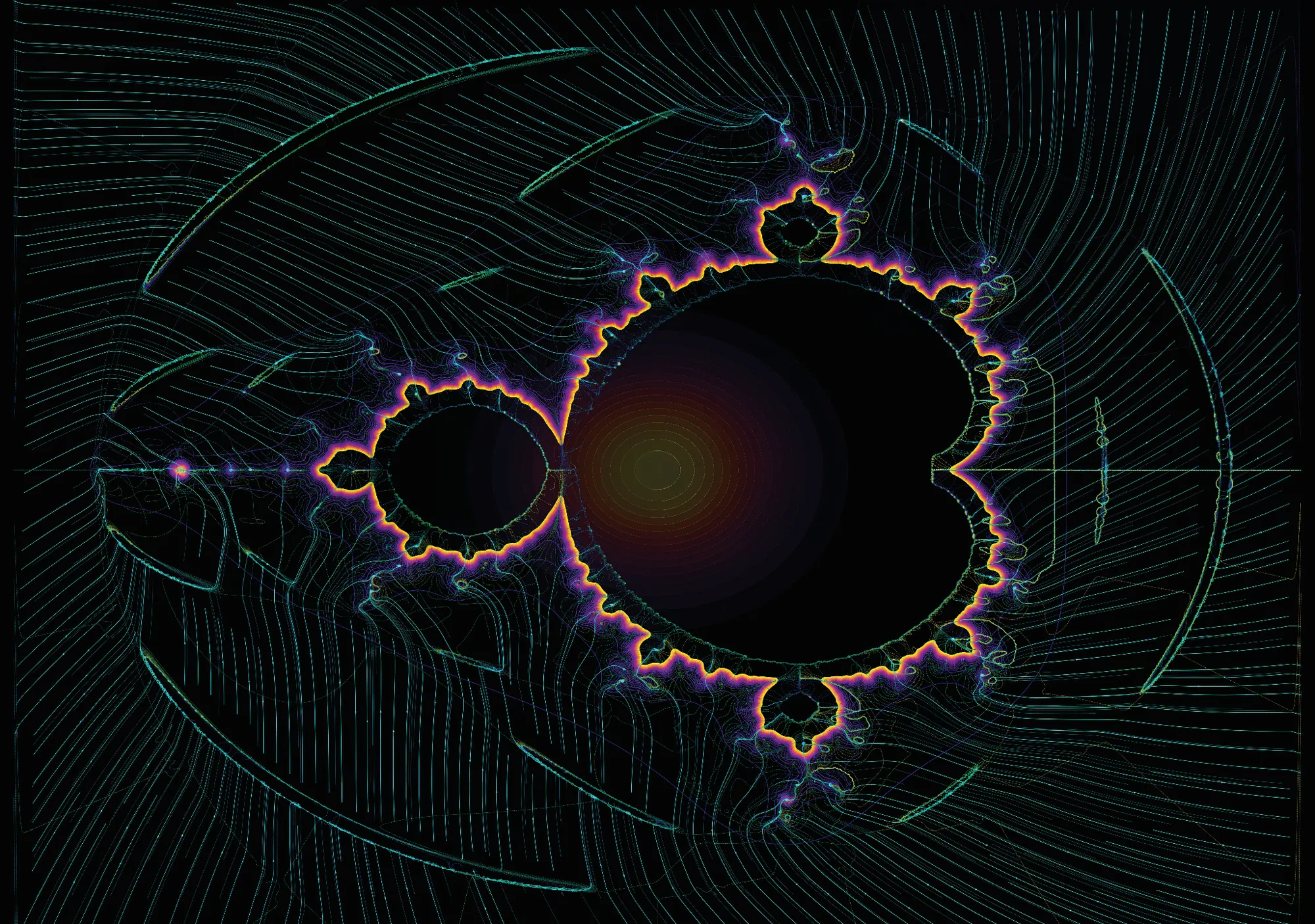
| 05 | Harmonic Synthesis and Temporal Morphogenesis of Fractal–Tensor–Network Ecologies | M | A harmonic atlas over the Mandelbrot set; morphogen equations; activity concentrating on filaments. | 54–61 |
| 06 | Source → Armada → DNA → Reality | M · P | A chain from source to form, with DNA as the stabilising channel. "Reality emerges as the equilibrium" of the chain. | 62–68 |
| 07 | Tensorial Emptiness and the Architecture of Reality | M · P | Matter is mostly void, so matter is organised emptiness. Reality = Void + Tensorial Relations. | 70–75 |
| 08 | The Planetary Tensor Grid and Harmonic Resonance | M · A | The Earth as a spherical standing wave. Spherical harmonics and great circles give nodal sites. | 76–80 |
| 09 | Fundamental Mathematical Frameworks Integrated in The Codex | M | Spherical harmonics, Chebyshev polynomials, Helmholtz, Poisson, Green’s functions, Dirac delta, Schrödinger, the harmonic oscillator. | 82–104 |
| 10 | The Schrödinger Equation and Atomic Orbitals | M · A | Orbitals and Pauli matrices read for designers. The Quantum Atlas and Band Plate; design protocols for corridors and bridges. | 106–123 |
| 11 | A Quantum–Relativistic Atlas | M | Einstein’s 1905 papers beside Schrödinger’s My View of the World. "The cone lattice is the structural grid; the wavefield is the occupancy pattern." | 124–129 |
| 12 | Coupled Dynamical Systems on a Constrained Manifold | M · A | Documents the simulation written for the book: a swarm on a sphere coupled to a wave field, projected stereographically. | 130–135 |
| 13 | Crystalline Megastructures and Architectural Ascension | A · M | Architecture as a contraction operator; the ascension operator; readings of Giza, Stonehenge, Borobudur, Chartres, Teotihuacan. | 136–140 |
| 14 | The Architecture of Ascension | A · P | Fractal megastructures, algorithmic design as spiritual practice, computational cartography. | 142–147 |
| 15 | Geometrical Codex Thesis | M | An equation sequence ending in the Super-Formula, a single variational functional. | 148–151 |
| 16 | Meta-Thesis on the Geometrical Codex | P · M | Six figure-essays from the atomic void to the Super-Formula. | 152–159 |
| 17 | AURA and the Integration of Environmental Architectures | A | The applied platform: geospatial, XR and AI tools for reading and repairing environments. | 160–165 |
| 18 | Foundations and Origins | P | An intellectual lineage from Pythagoras to the present, in six "resonances". | 166–173 |
| 19 | Time Traveling Agents Across the Contours of Space-Time | P | History as a resonant field with surges and vortices, not a line. | 174–179 |
| 20 | The Unbroken Light | P | A theological essay: unity, with the cosmos as a prism. | 180–182 |
| 21 | Omega as Architecture | P | A response in the spirit of Teilhard de Chardin, ending with a test: "How does this architecture increase communion?" | 184–187 |
| 22 | Spheres and Convergence | P | Sloterdijk’s spheres beside Teilhard’s Omega; architecture as planetary interior. | 188–192 |
| 23 | The Codex Swarm | A · P | Autonomous agents for ecological restoration, governed by tuning; the restoration loop. | 194–198 |
| 24 | The Convergence Theorem of Harmonic Operators | M | A Banach-space restatement with a Lyapunov functional. | 200–202 |
| 25 | Spectral Stability and Harmonic Convergence | M | Spectral radius below one: harmonic modes decay to the fixed point. Followed by the poem "The Edge of Space". | 204–211 |
Equilibrium without coercion.
The opening chapters establish the book’s central device. A sequence of operators, each of which brings states closer together, is composed into one map; by Banach’s theorem such a map has a single fixed point to which everything converges. The book calls the result "the nonviolent attractor"II, p. 33, 41 and attaches to it a story: a harmonic lattice around the Earth, "not made of ships or soldiers but of harmony itself."II, p. 17
For design the transferable idea is the contraction itself: a process that reduces difference at every step and therefore settles, as opposed to one that is forced into place.
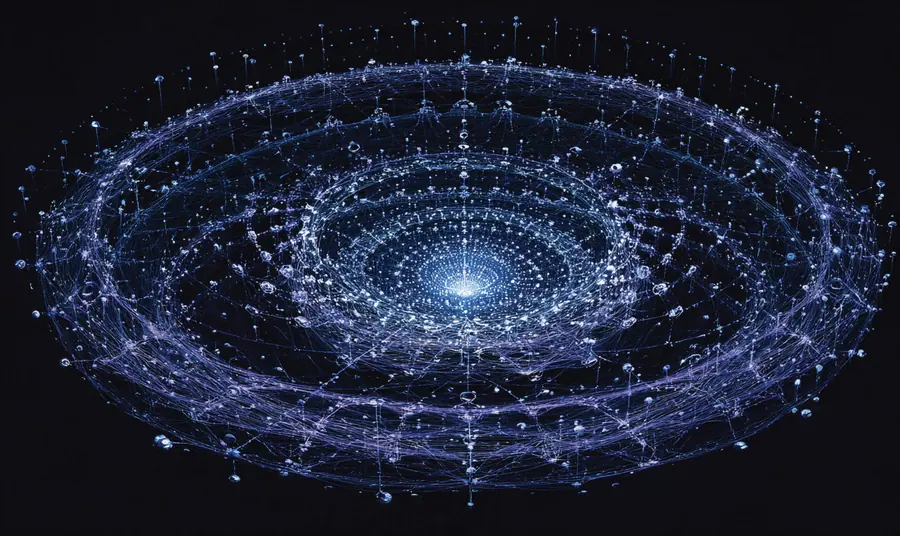
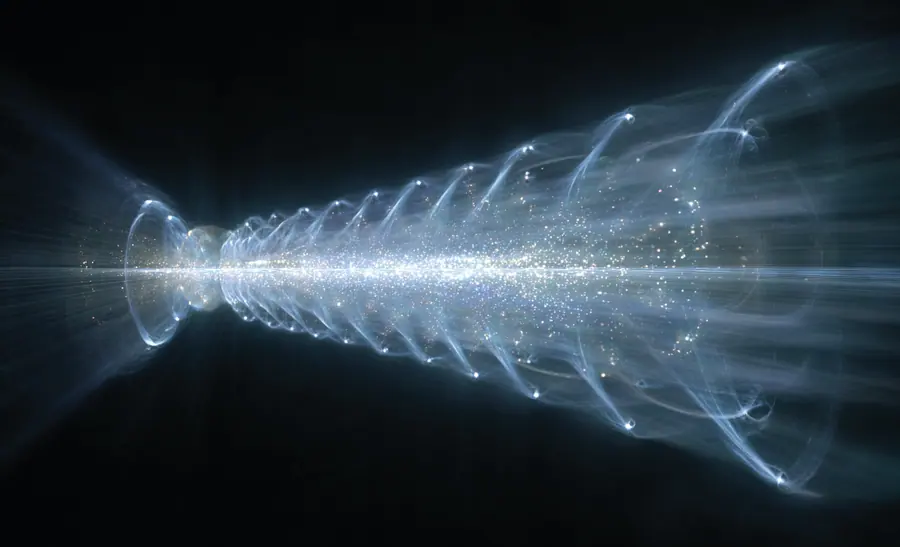
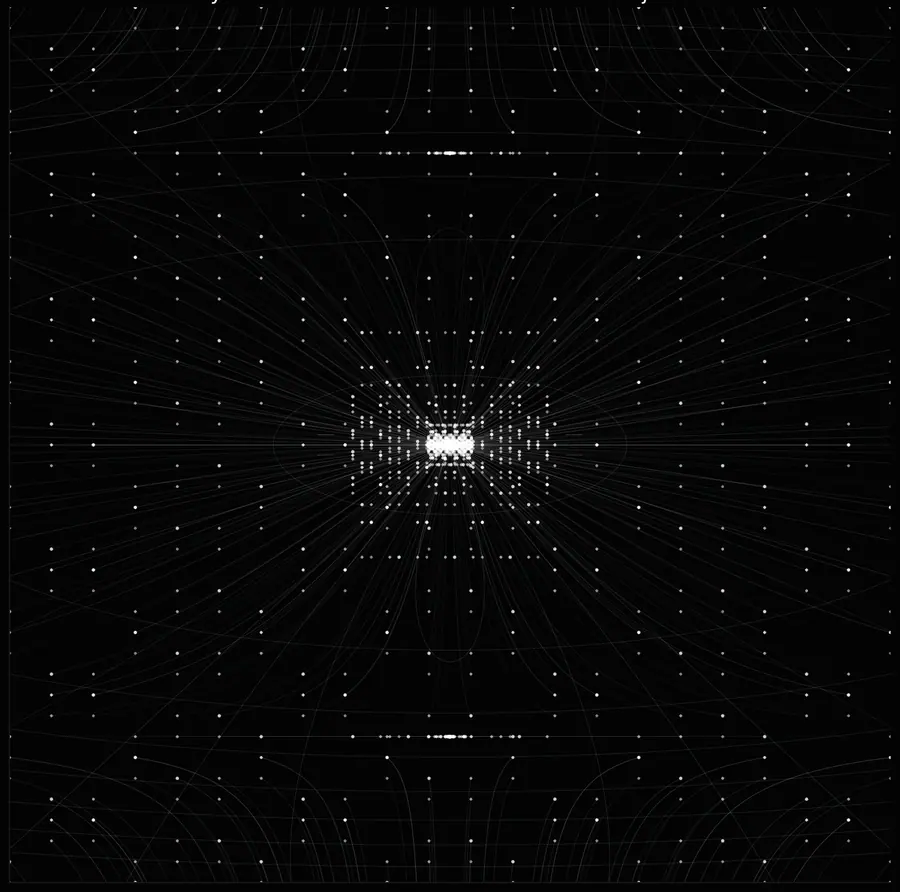
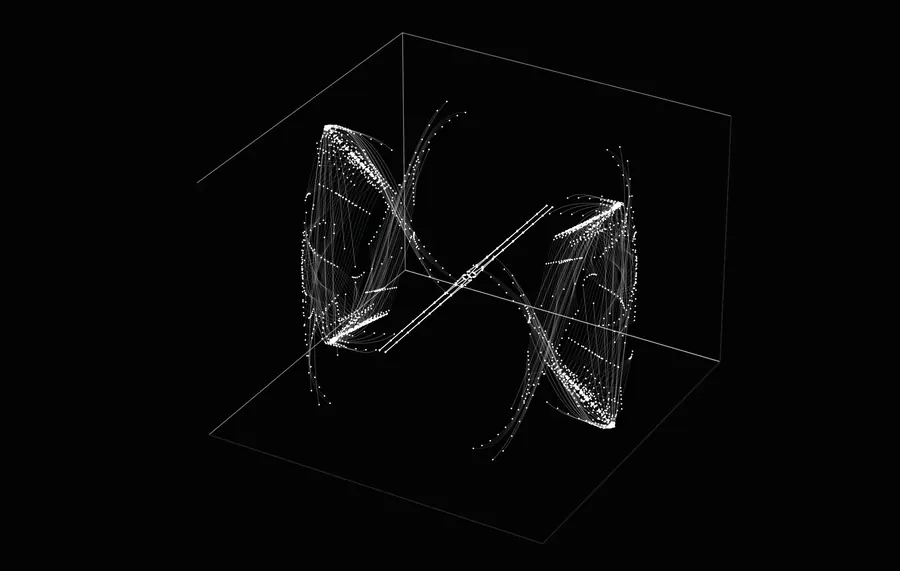
What appears as ornament is in fact invariance rendered visible.
Vol. II: The Codex, p. 42
Harmonic synthesis and the generative void.
Chapter 5 overlays harmonic streamlines on the Mandelbrot set and follows how activity concentrates along filaments at its boundary. Chapter 6 extends the chain from source to living form, with the double helix as the channel in which pattern is stabilised. Chapter 7 turns to the atom: since matter is overwhelmingly empty space, the book treats emptiness as the medium of structure and writes "Reality = Void + Tensorial Relations."II, p. 71–73
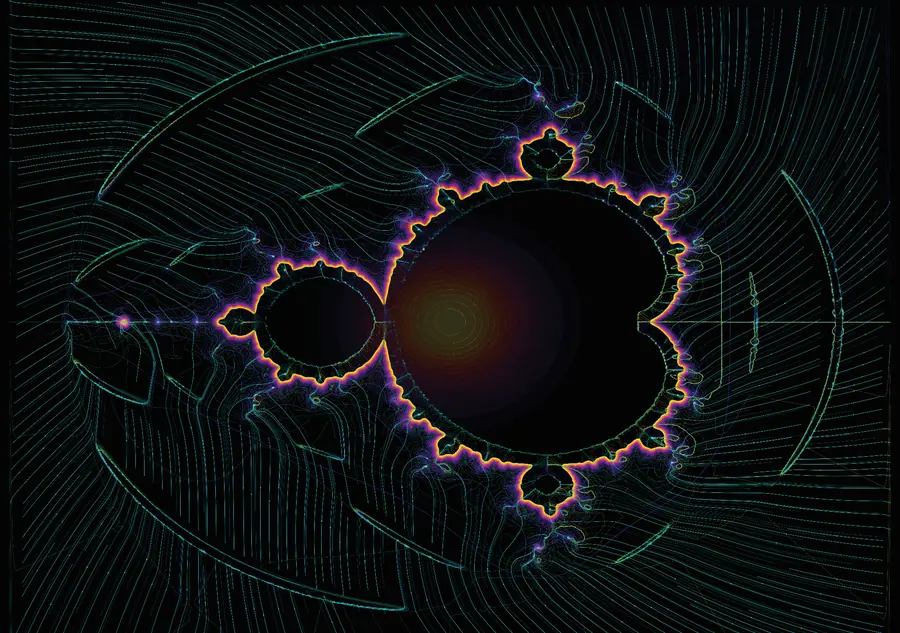
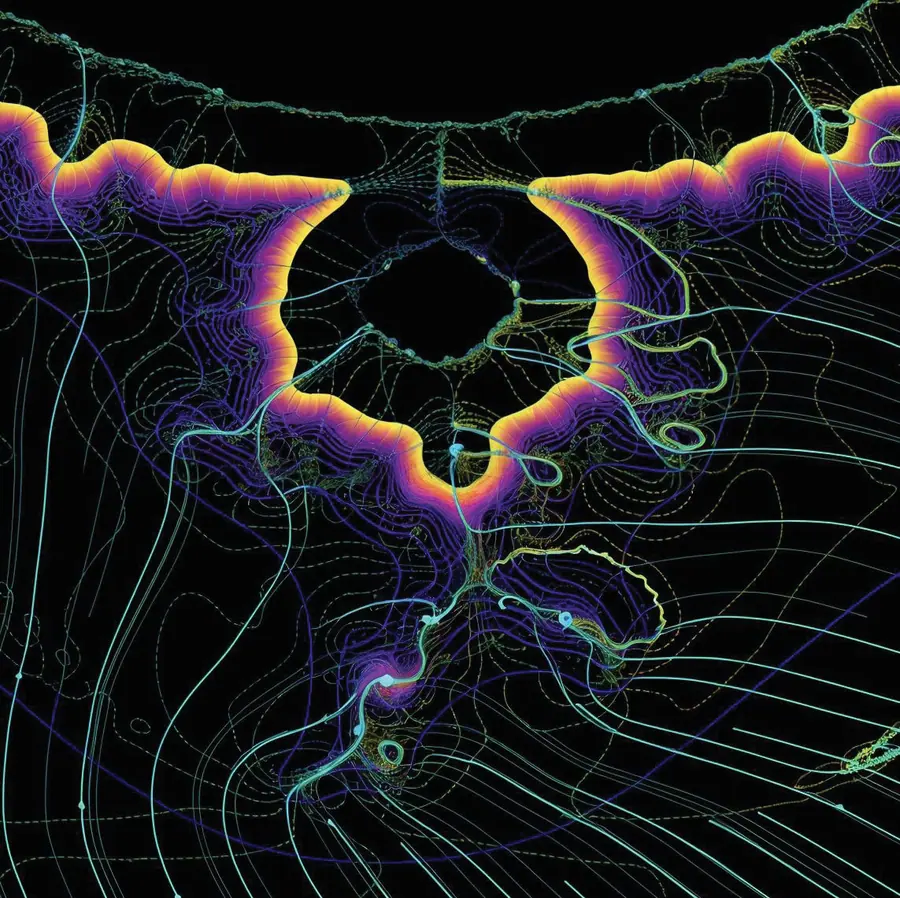
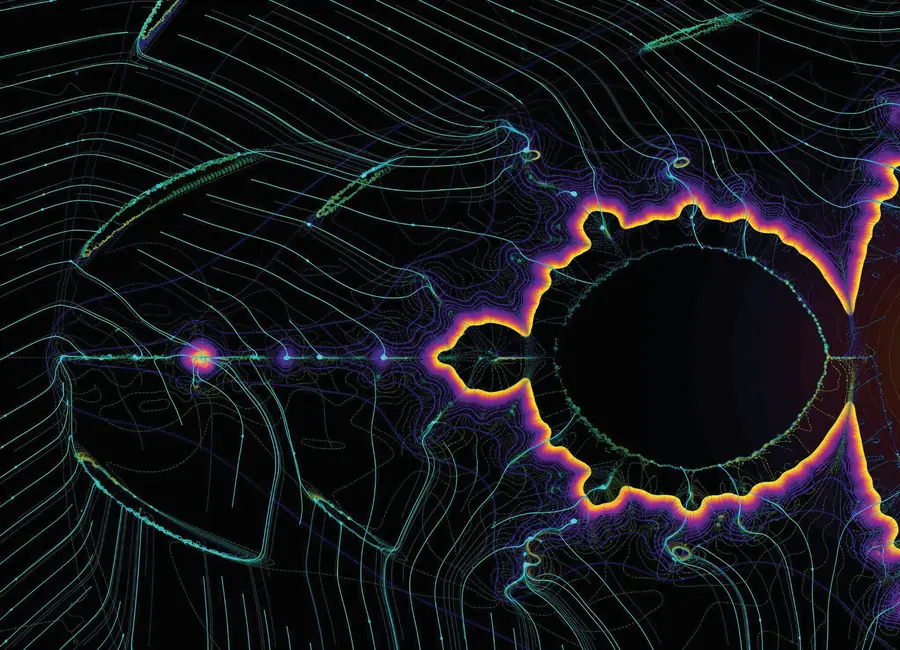
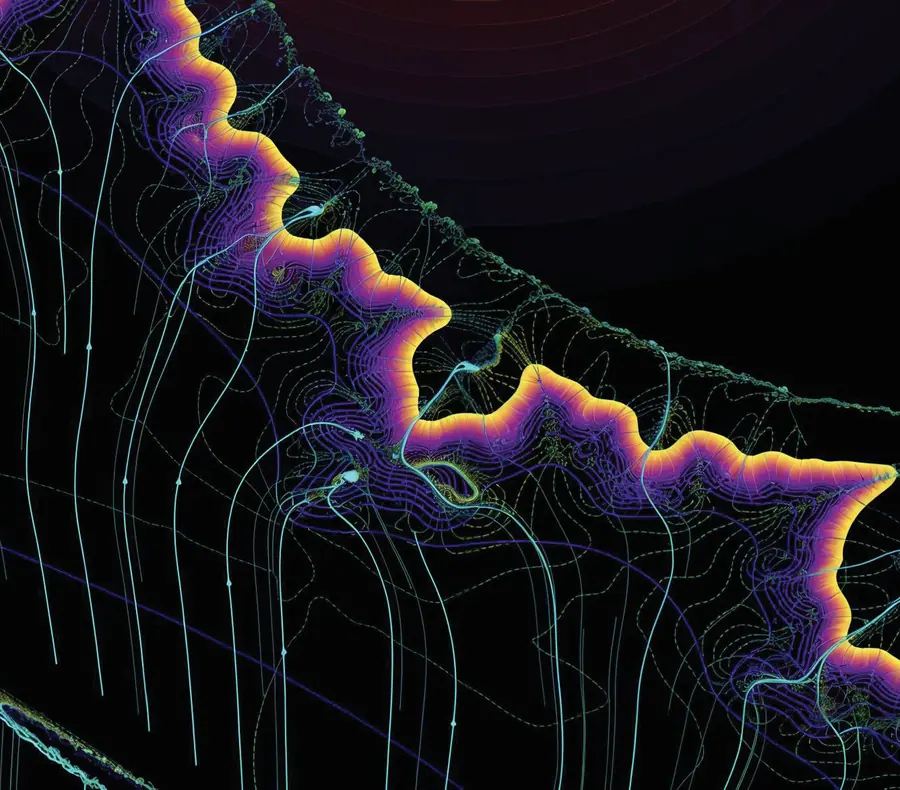
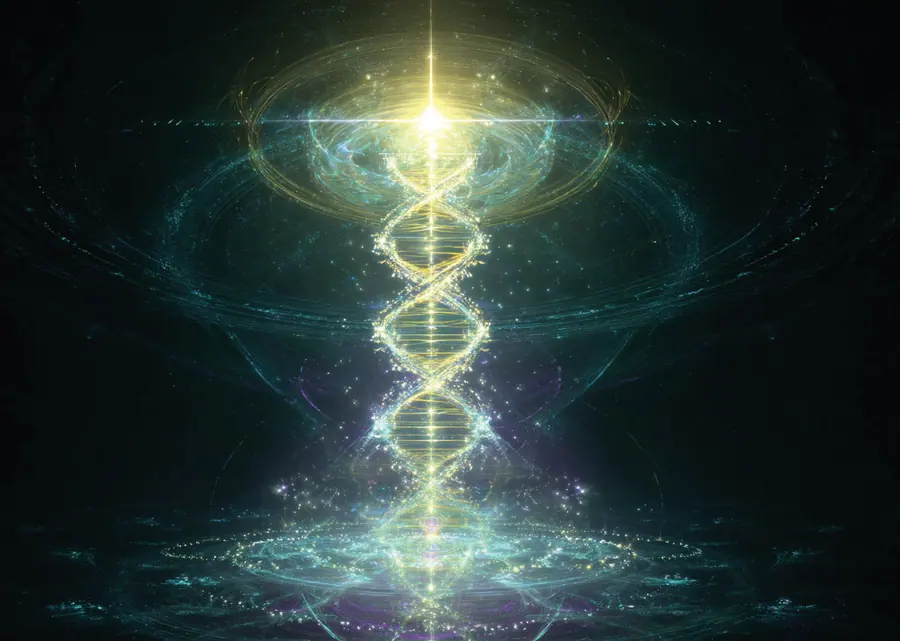
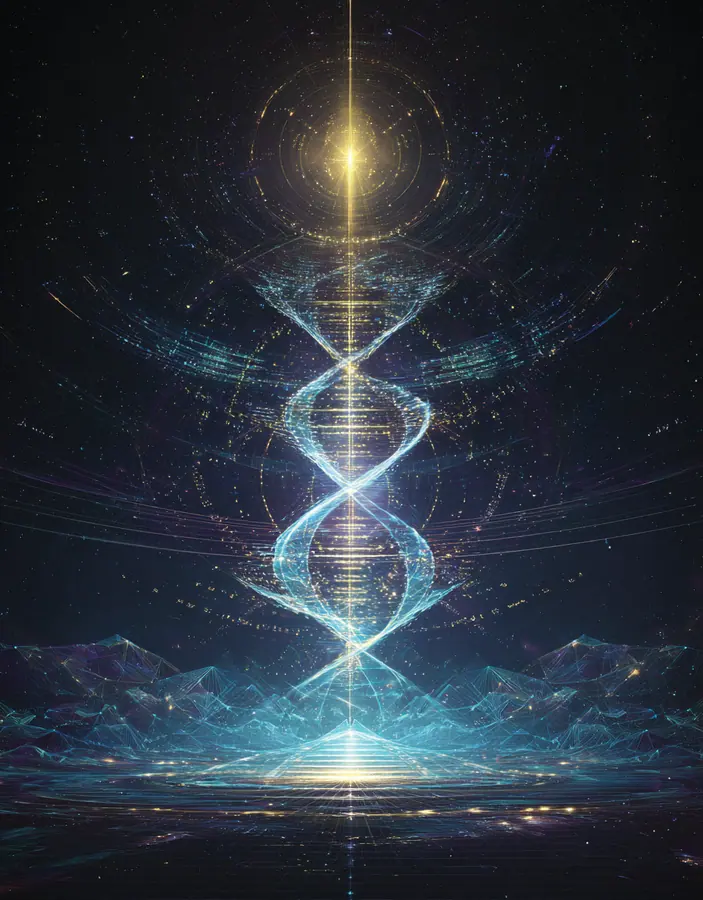
Emptiness is not absence, but the loom on which reality is woven.
Vol. II: The Codex, p. 71
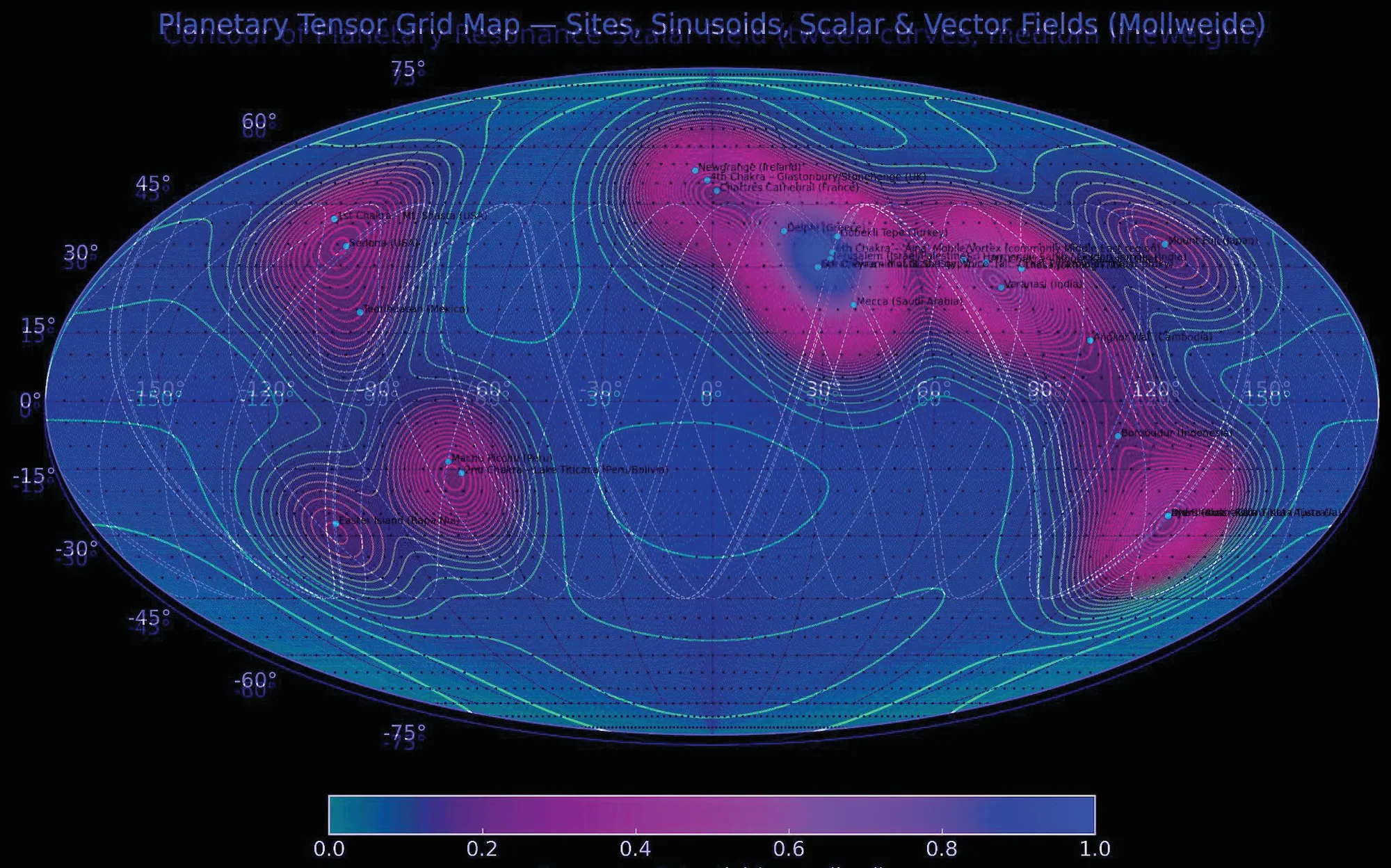
The planet as a standing wave.
Fig. 10 · Planetary Tensor Grid Map
Vol. II: The Codex, p. 80
The planetary tensor grid.
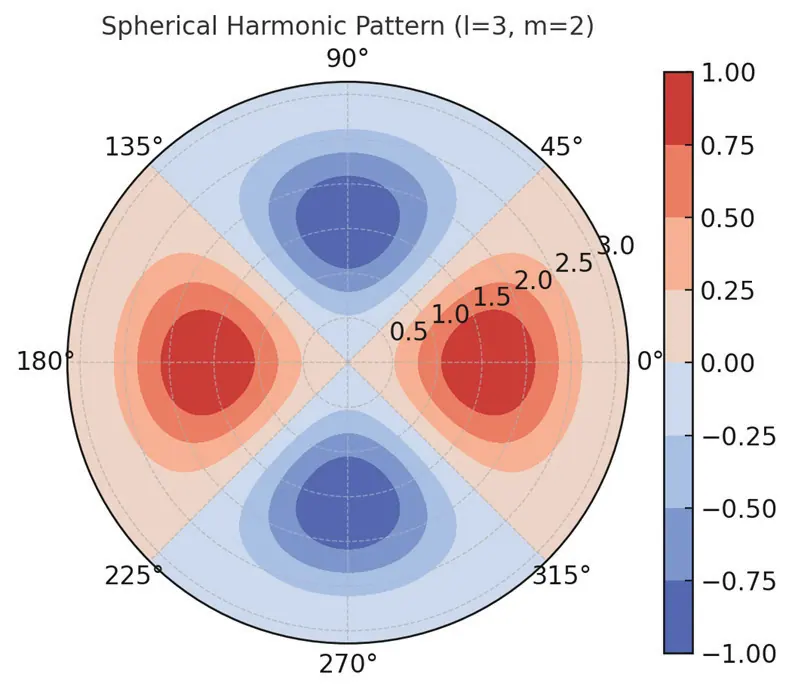
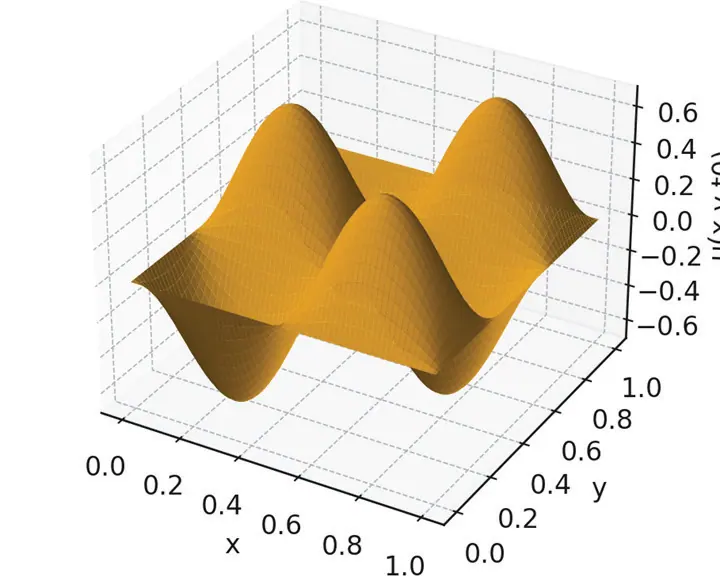
Chapter 8 models the Earth as a vibrating sphere. Spherical harmonics, the functions that describe the modes of such a body, are combined with sinusoidal great circles; where they intersect the book places nodes and associates them with Mount Shasta, Giza, Stonehenge, Uluru and Mount Kailash.II, p. 77–80 Chapter 9 supplies the mathematical toolkit: spherical harmonics, Chebyshev polynomials, the Helmholtz and Poisson equations, Green’s functions described as the "memory kernel of space", and the quantum harmonic oscillator.II, p. 82–104
| Framework | What it describes | Design reading in the book |
|---|---|---|
| Spherical harmonics | Modes of vibration on a sphere | Planetary nodes and corridors |
| Chebyshev polynomials | Oscillation with bounded amplitude | Rhythm and nodal density |
| Helmholtz equation | Standing waves in bounded domains | Lattices, rooms, plates |
| Poisson equation | Potential from a source distribution | Fields around masses and voids |
| Green’s functions | Response to a point source | "Memory kernel of space" |
| Dirac delta | An ideal point source | "Seed-point of resonance" |
| Harmonic oscillator | Quantised energy levels | A ladder of states |
The quantum atlas.
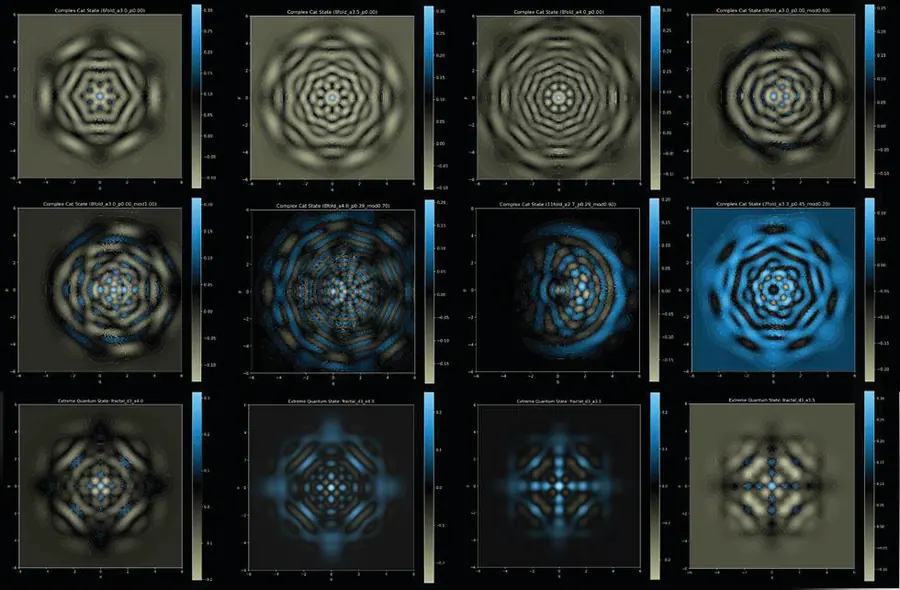
Chapter 10 contains the most direct design method in the book. Electron orbitals and standing-wave planforms are arranged by symmetry and order into an atlas, and read as architecture: rosette patterns as rooms, band patterns as routes. Two protocols are given, one for synthesising corridors and one for morphing bridges and beams.II, p. 115–122
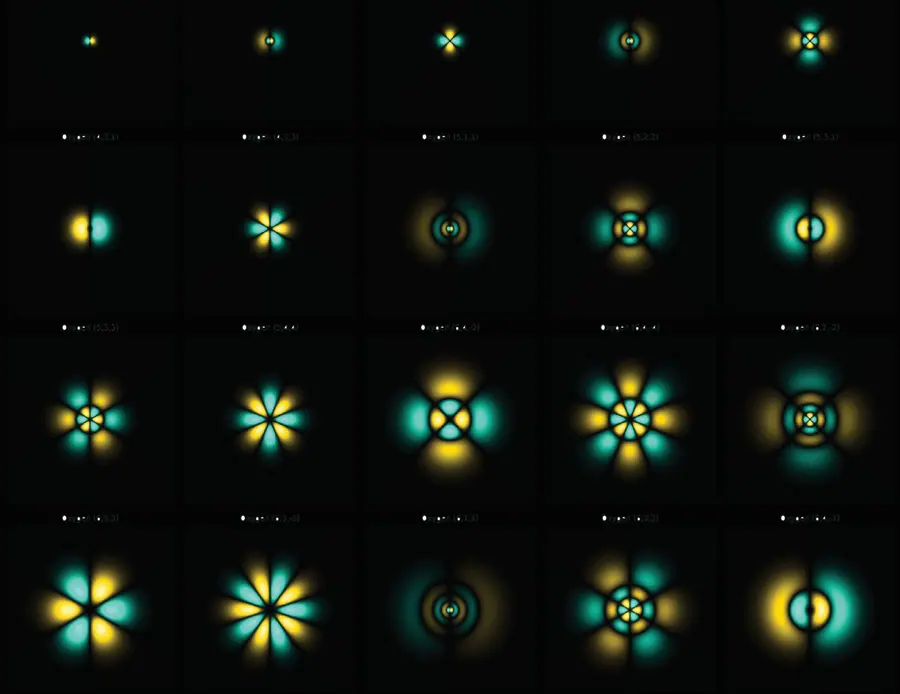
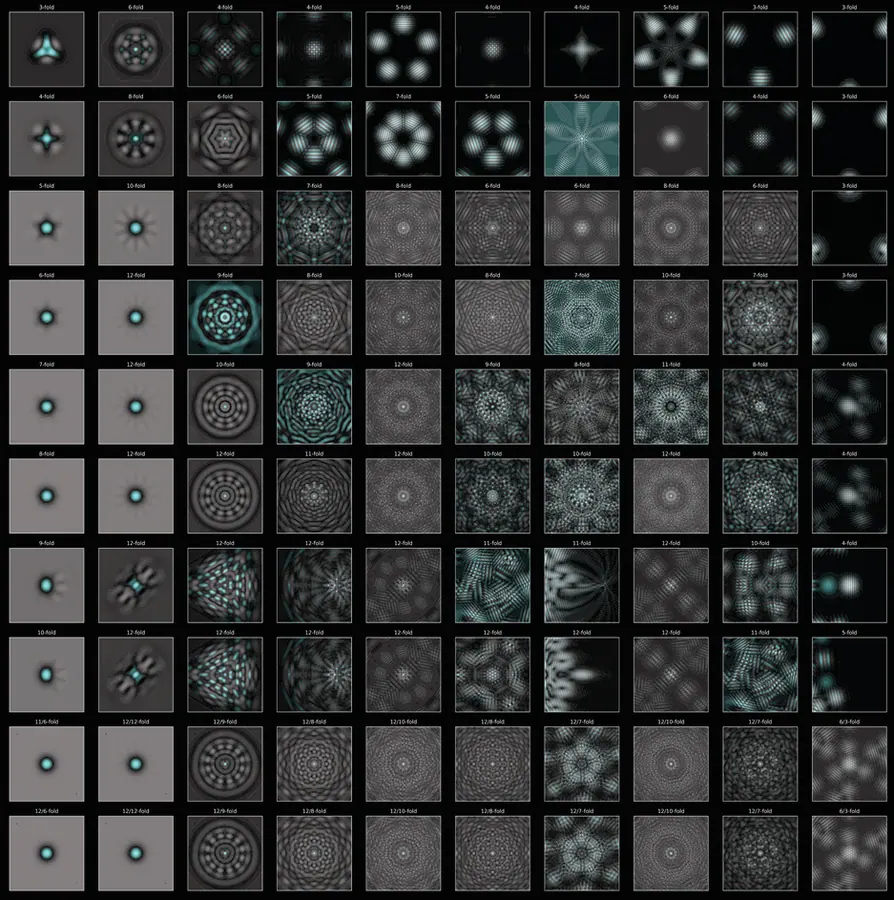
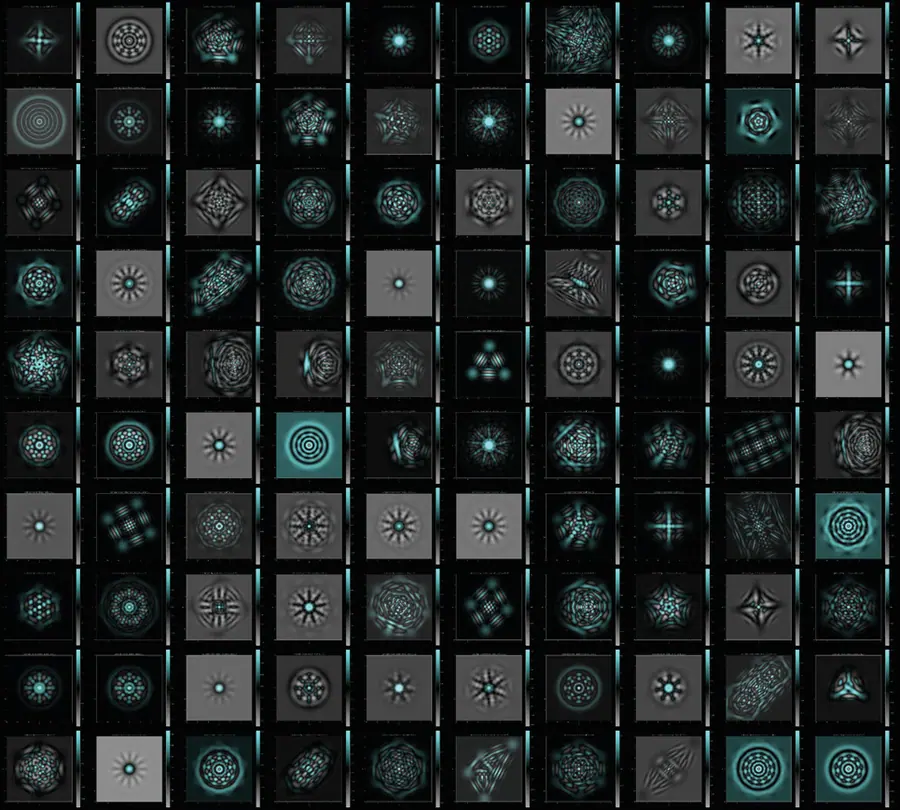
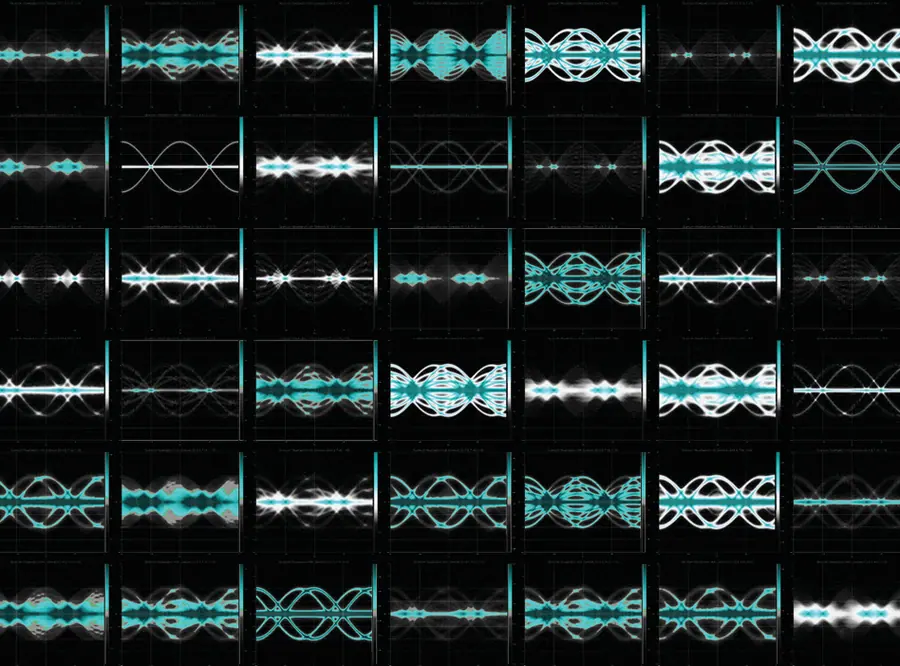
Rooms from rosettes, routes from bands.
Vol. II: The Codex, p. 122
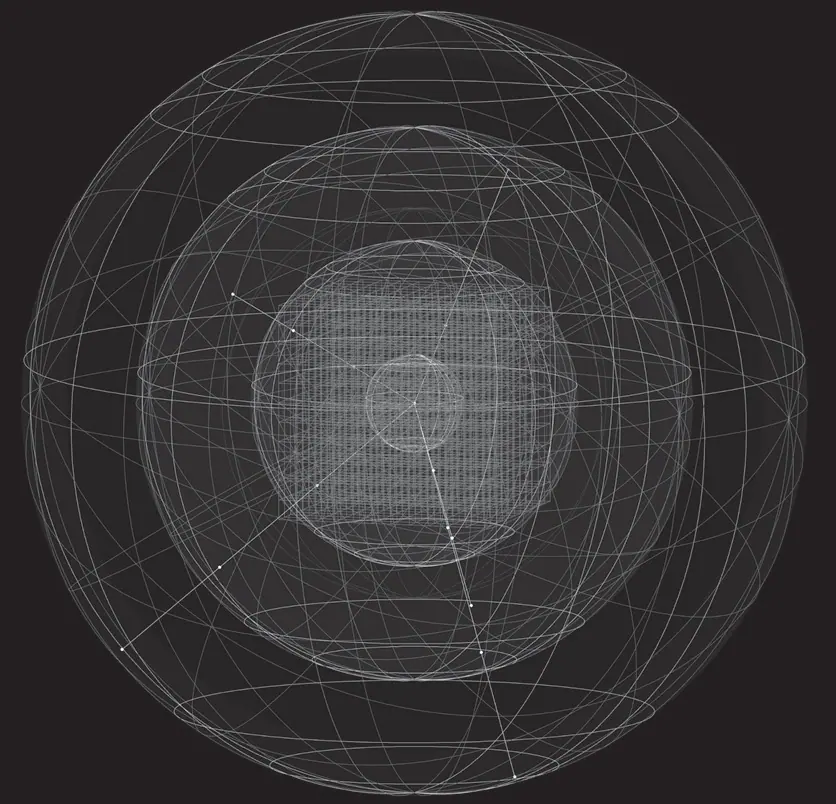
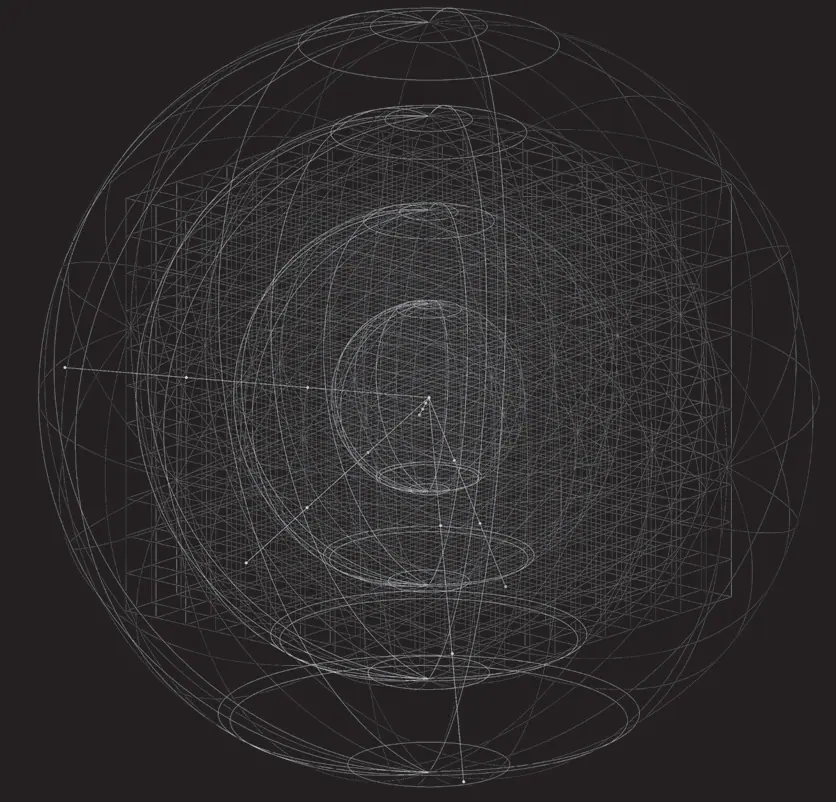
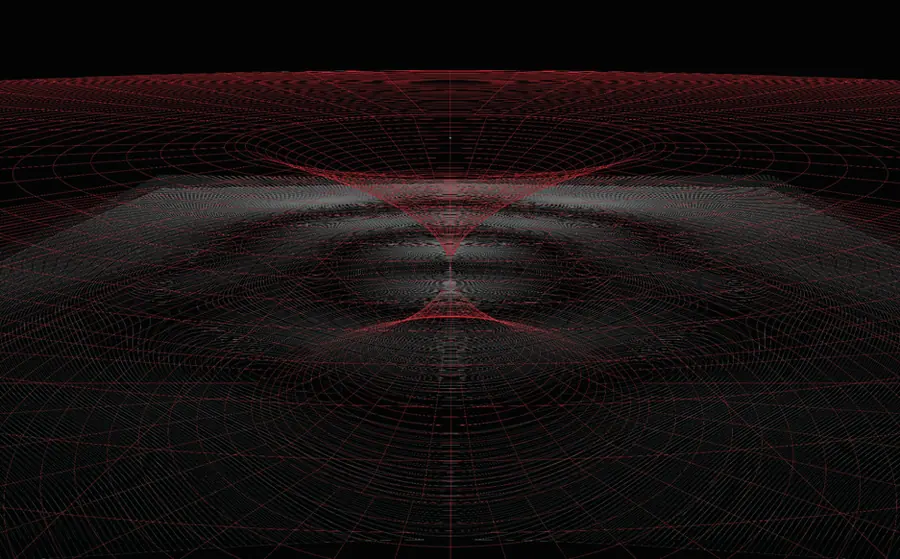
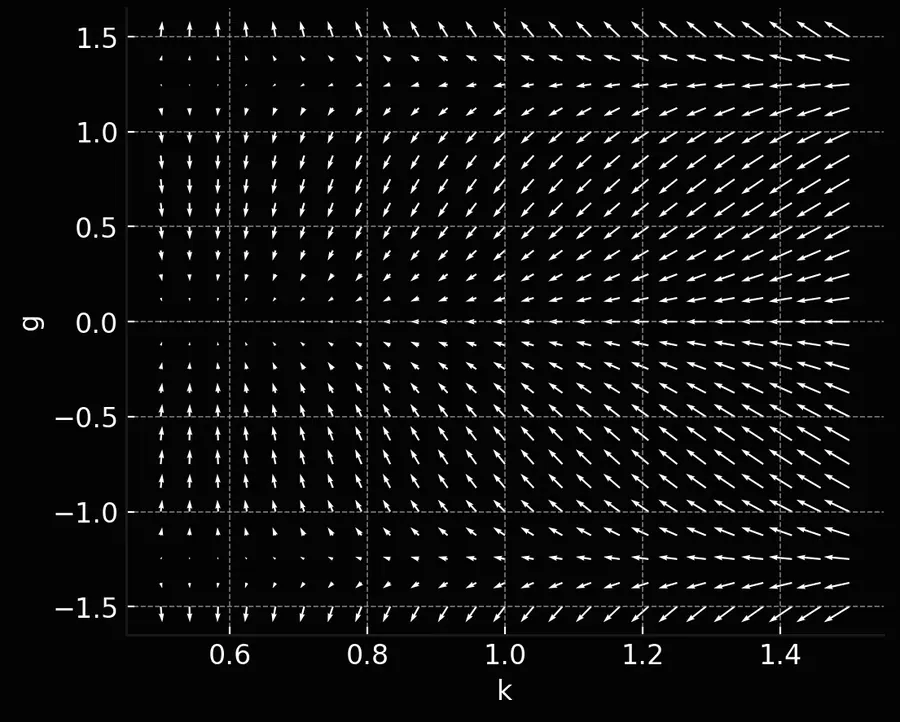
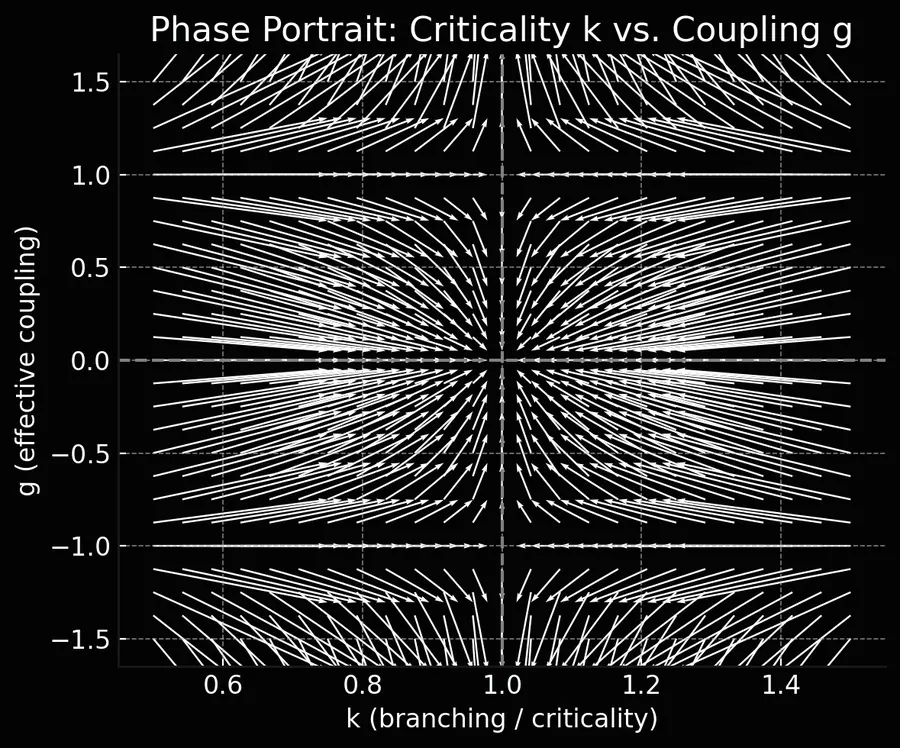
Chapter 12 documents a simulation: particles flocking on the surface of a sphere, coupled to a complex wave field, tuned near a critical point and projected onto the plane. "It is simulating relations, and the image is the trace those relations leave on perception."II, p. 134
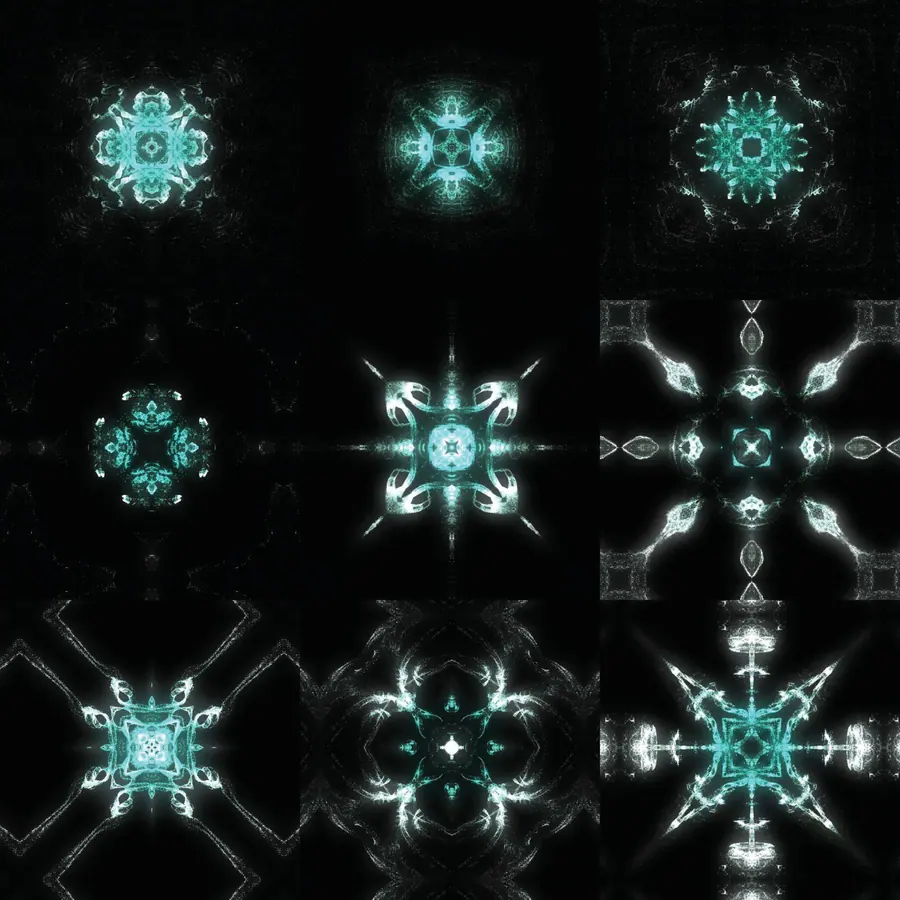
Crystalline megastructures and the super-formula.
Here the book reaches architecture. A building is described as an operator that contracts the planetary field into a human-scaled, crystalline configuration, following the sequence Void, Relation, Resonance, Form. "Architectural ascension is mathematically inevitable where resonance and human intention intersect."II, p. 139 Chapter 14 names the practice this implies: "By using algorithms to create structures that align with the natural flow of energy, architects co-create with the Earth and the cosmos."II, p. 143
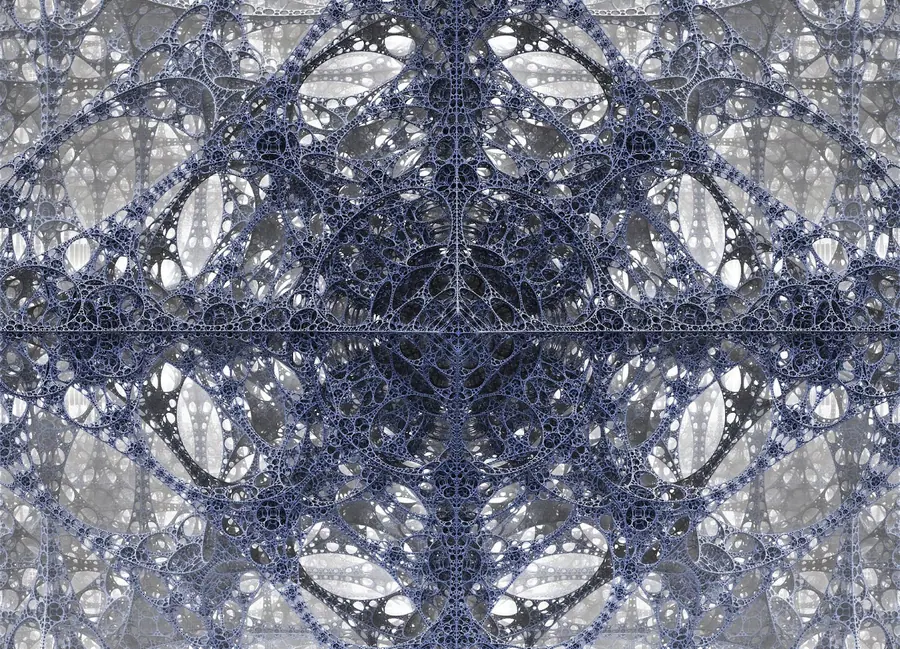
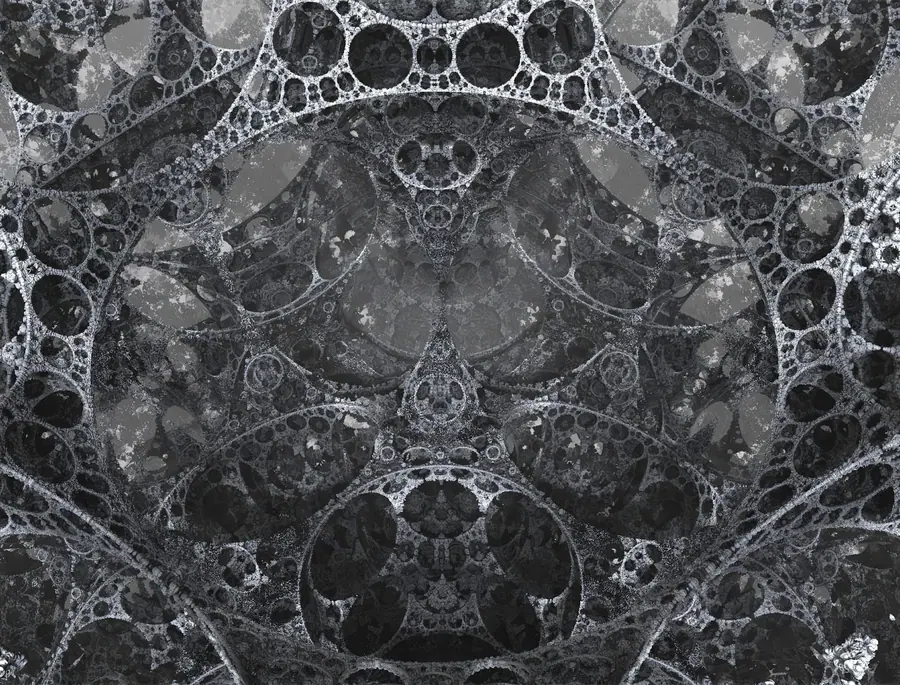
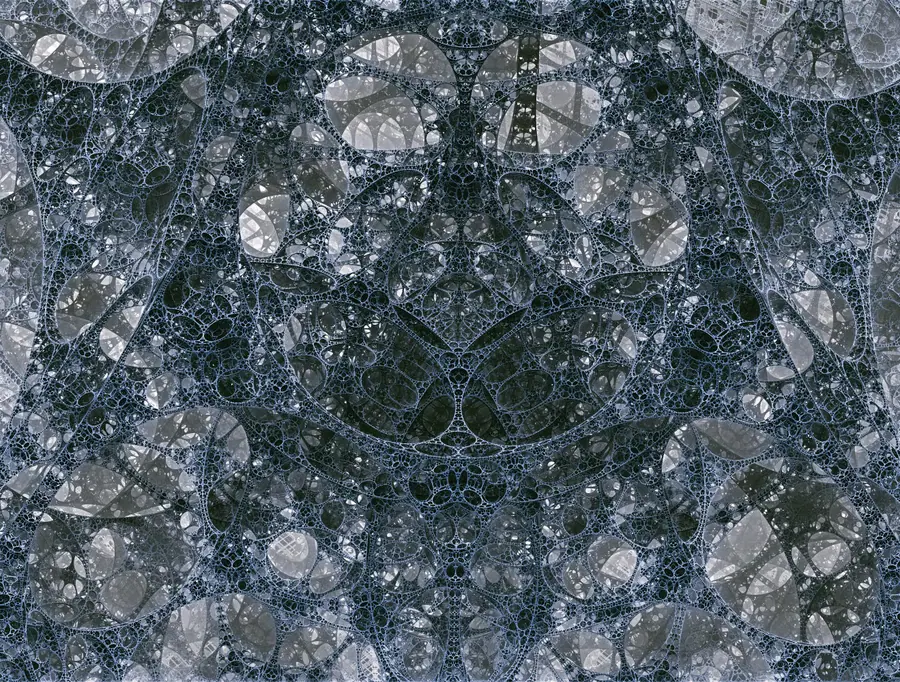
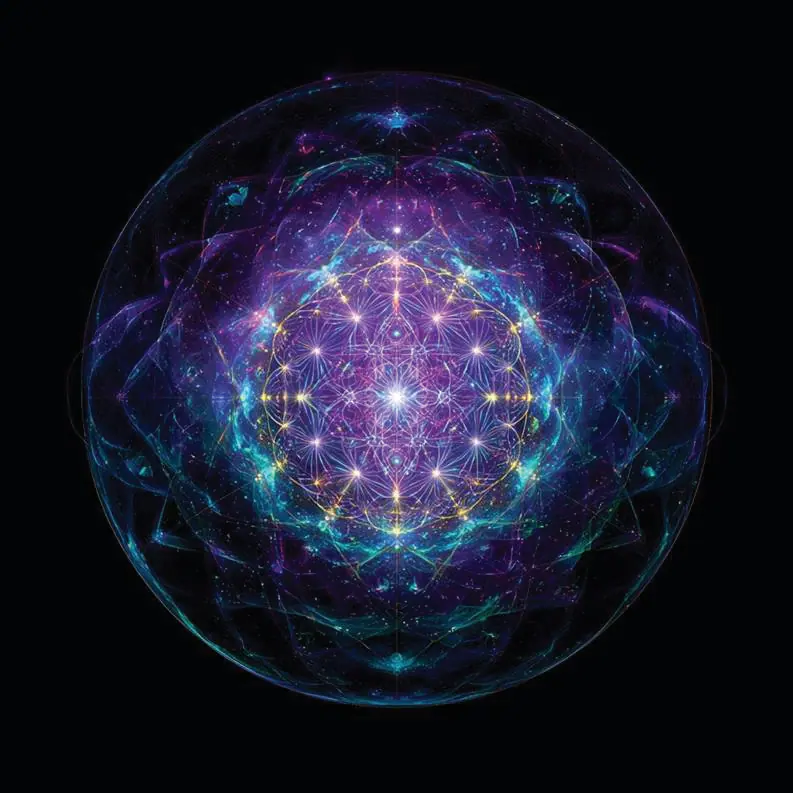
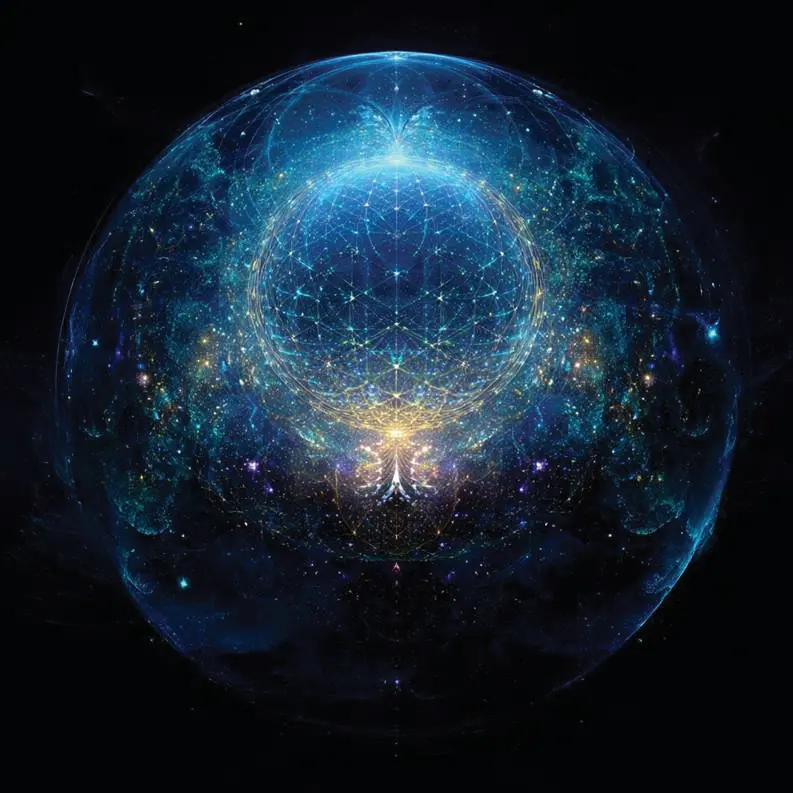
Chapters 15 and 16 gather the preceding equations into one variational statement, the Super-Formula, and comment on it through six figure-essays.

Application: AURA and the Codex Swarm.
Two chapters return the Codex to practice. Chapter 17 documents AURA, a geospatial and extended-reality platform for reading environments and testing interventions; it is described on the Territory page. Chapter 23 proposes the Codex Swarm, a set of autonomous agents for ecological restoration: water, soil, vegetation, fire, corridors and human constraints.II, p. 195–198
- Sense
- Diagnose
- Propose
- Simulate
- ExecuteDistributed
- Verify
The Earth is not broken.
Vol. II: The Codex, p. 195
Lineage, history, theology.
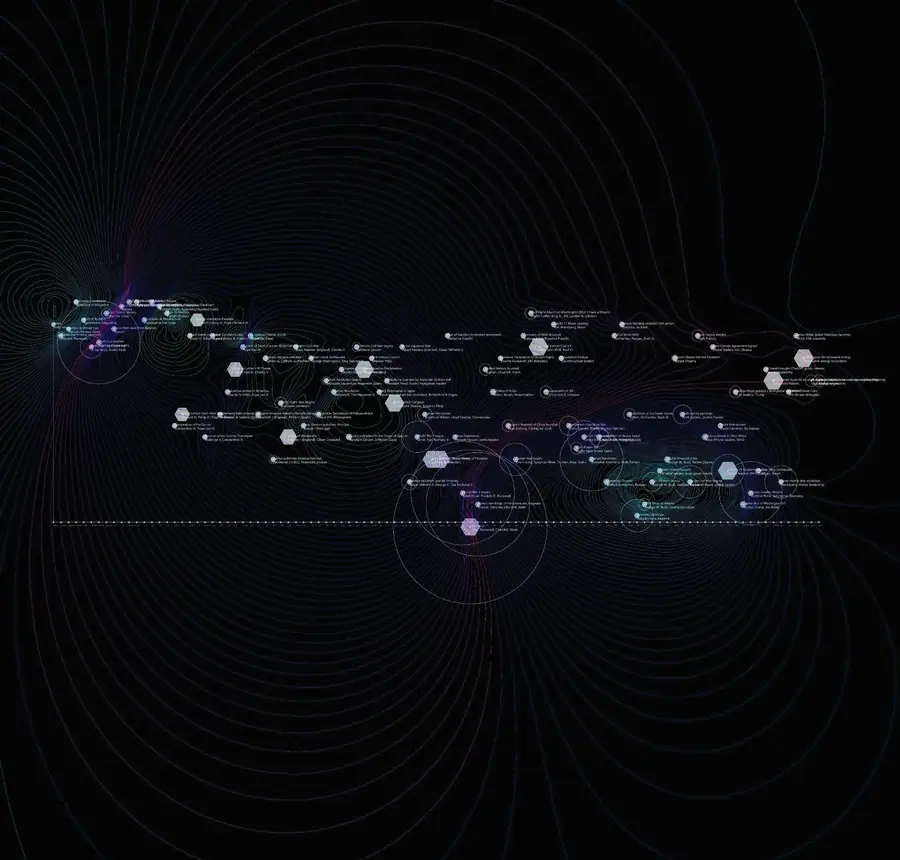
The closing philosophical chapters place the work in a tradition the book calls architecture as applied cosmology, running from Pythagoras, Plato and Vitruvius through Kepler, D’Arcy Thompson, Fuller and Frei Otto to contemporary computational designers.II, p. 167–173 Chapter 19 draws history as a field: "not an arrow but a field; not a straight road but an ocean of currents."II, p. 176
Chapters 21 and 22 are written as responses to the manuscript, in the spirit of Pierre Teilhard de Chardin and Peter Sloterdijk. They leave the practice with a test that any project can be put to: "How does this architecture increase communion?"II, p. 187
Physics becomes theology written in differential equations. Geometry becomes prayer traced in space.
Vol. II: The Codex, p. 182