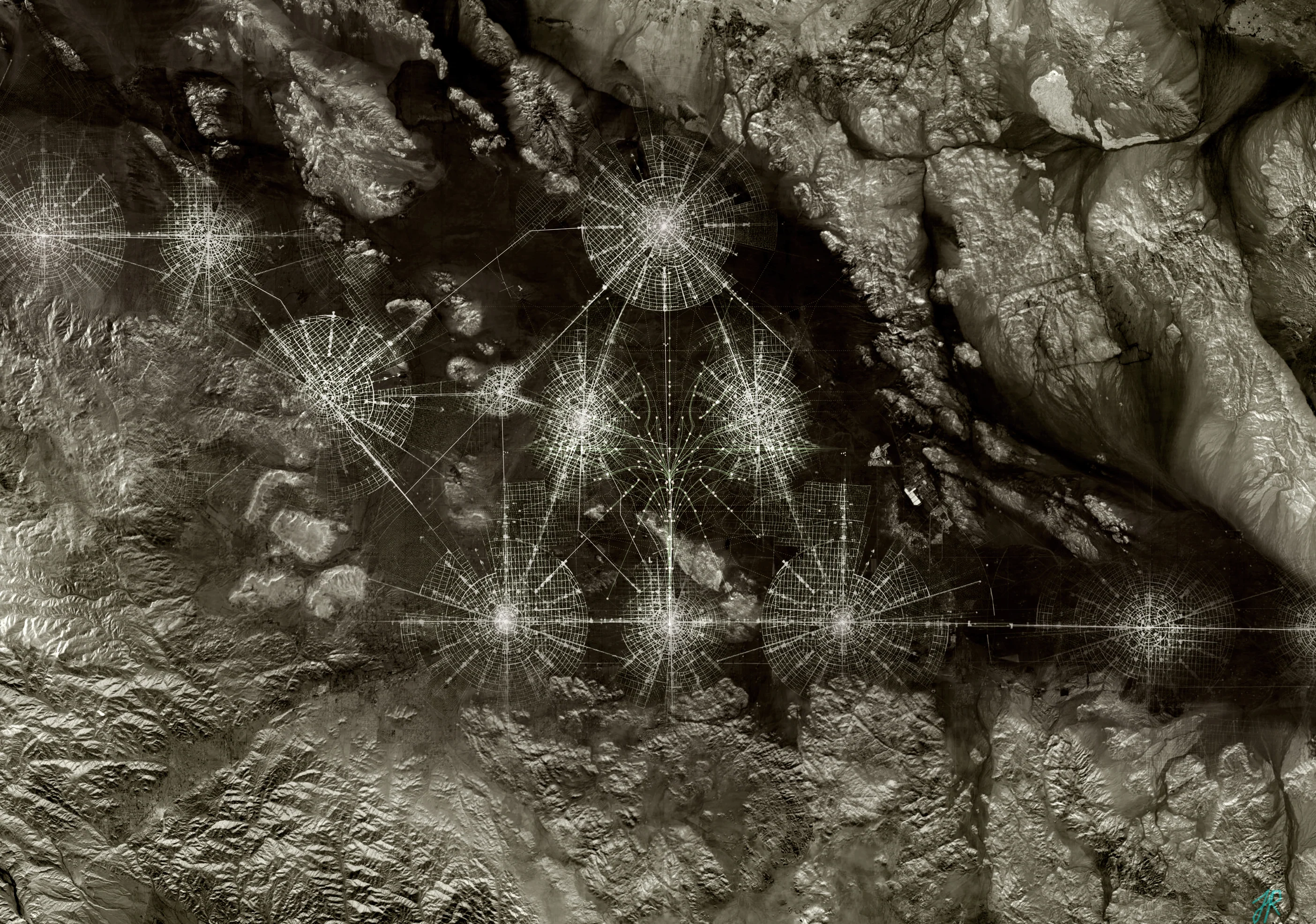
To build in harmony with the living Earth.
ATLAS TERRAFORMA exists to bring the built world and the natural world into harmony. We design so that cities, buildings and landscapes take part in the Earth’s own systems of water, energy, matter and life, as a forest takes part in its watershed: returning what they draw, and making more life possible around them.
The word for this is symbiosis. Civilization and the biosphere are not two parties to be balanced against each other. They are one body, and they thrive or fail together. An architecture worthy of that fact does not sit on the land as an interruption; it grows out of the land’s geology, climate and ecology, and gives form to the relationship between a people and the place that sustains them.
This is a spiritual undertaking as much as a technical one. The research behind the practice holds that the Earth is not a backdrop and not a resource. It is a living whole to which humanity belongs, and to build is to take part in its order. We build with measurement and we build with reverence. Beauty, in this work, is what coherence with the living world looks like.
The aspiration has an old name: Heaven on Earth. We mean it without the iconography of any single tradition, and we mean it literally: places of such harmony between human life and the life around it that to dwell in them is to be restored. The second volume of the research calls our home "the Eternal Eden, Earth, fallen and ascending."II, p. 17 The work of architecture is to help it ascend.
We are destined for harmonic synergetic integration in the unified functioning of earth systems.
Terrestrial Architecture, Vol. I, p. 47
01.1The site is the planet
The practice begins from one observation. Buildings are drawn inside a property line, while the systems that sustain them, water, energy, material and climate, are continuous across the Earth. Harmony cannot be achieved one parcel at a time; it has to be designed at the scale of the systems themselves.
The research behind the practice is set out in two books. Terrestrial Architecture (2024) argues that design institutions are "concerned solely with parcels and specific sites" and that no shared philosophy yet explains how natural systems and architecture can co-function.I, p. 10–11 It proposes "a new kind of potential project heuristic that is terrestrial in scale and fidelity."I, p. 11 Volume II: The Codex (2026) extends the argument into mathematics, treating built form as a way of bringing settlement into resonance with the planet’s own patterns.
Four working propositions follow from the books, and they organise this site.
As the human environment and the natural environment flourish together, the two also deteriorate as one.
Terrestrial Architecture, Vol. I, p. 20
| No. | Proposition | Consequence for design | Source |
|---|---|---|---|
| P.01 | The Earth is a single self-regulating system. | Every project is modelled inside its watershed, supply chains and climate, never as an isolated object. | Vol. I, ch. 1–3 |
| P.02 | In nature, form governs the flow of energy. | Morphology is treated as environmental performance: the shape of a thing is how it handles light, water, heat and matter. | Vol. I, pp. 39–50 |
| P.03 | Planetary design needs data infrastructure as architecture. | Remote sensing, GIS and digital twins become building programmes: places where the Earth is described, modelled and projected. | Vol. I, ch. 6–12 |
| P.04 | Recursive geometry can coordinate complexity. | Fractal and grid systems organise large programmes and ecological flows from one rule set, across scales. | Vol. I, ch. 5, 13–14; Vol. II, ch. 13–14 |
A greater totality of the built environment exists beyond a single parcel.
Terrestrial Architecture, Vol. I, p. 10
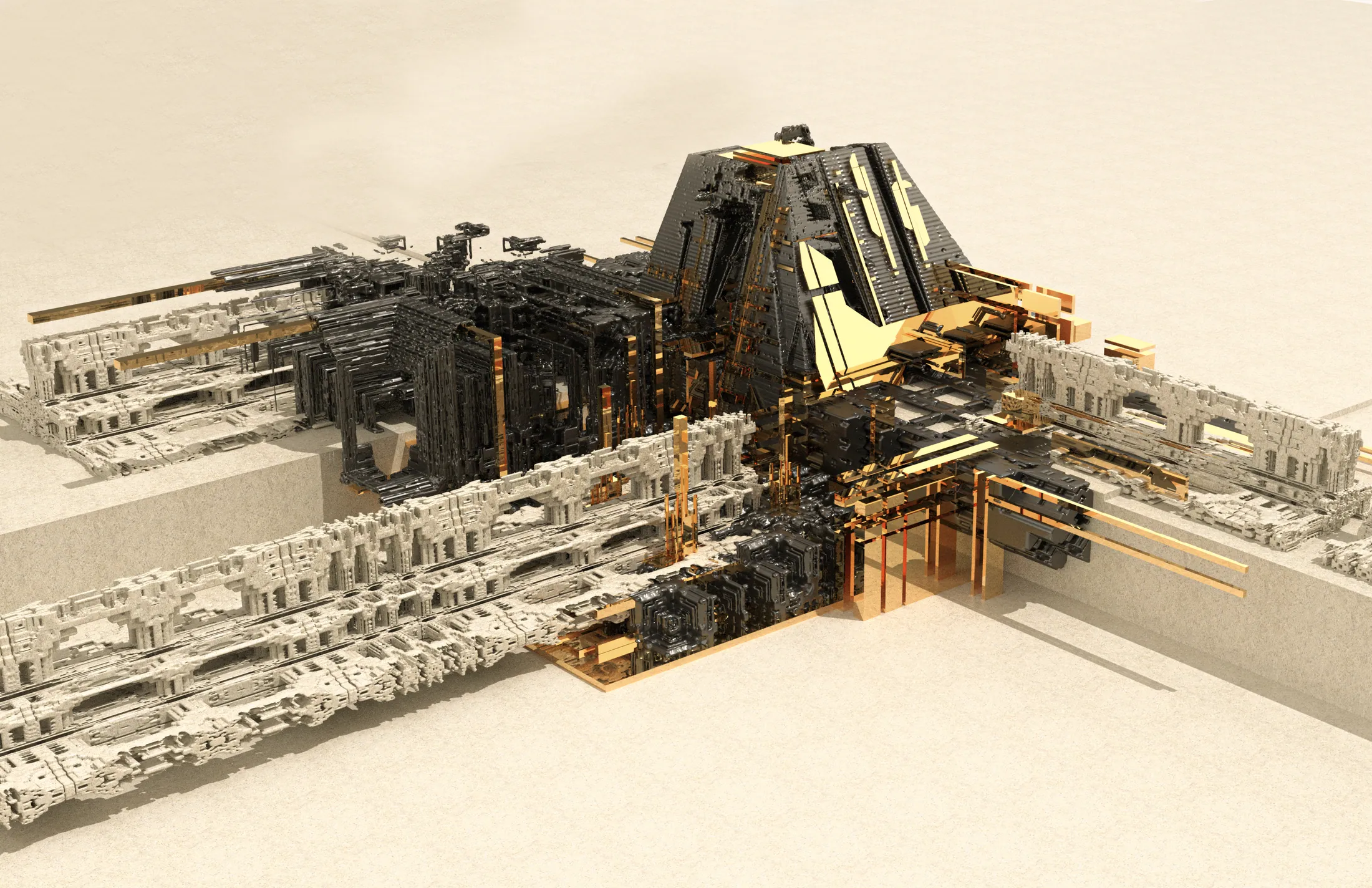
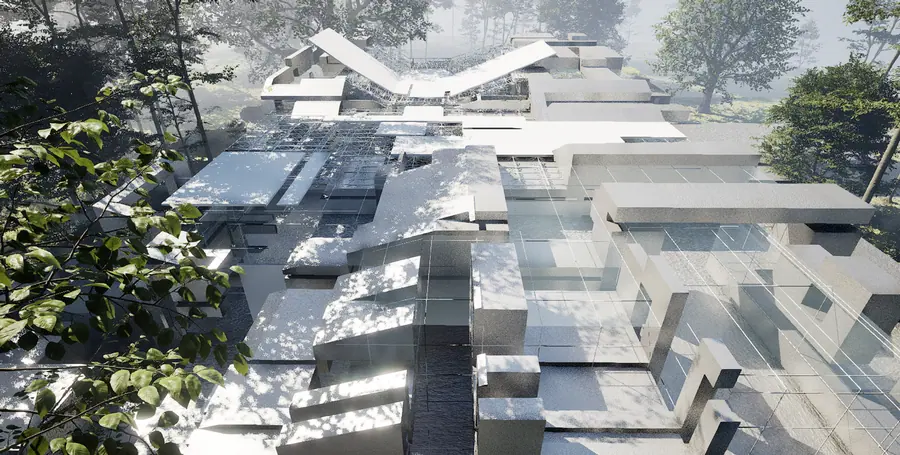
Monumental, and made of rules.
Megastructure on the desert floor
Mathematical Forms series · Speculative
One order, six scales.
The work is continuous from the globe to the component. Each scale has its own instruments and its own drawings; the same commitment to harmony with living systems runs through all of them.
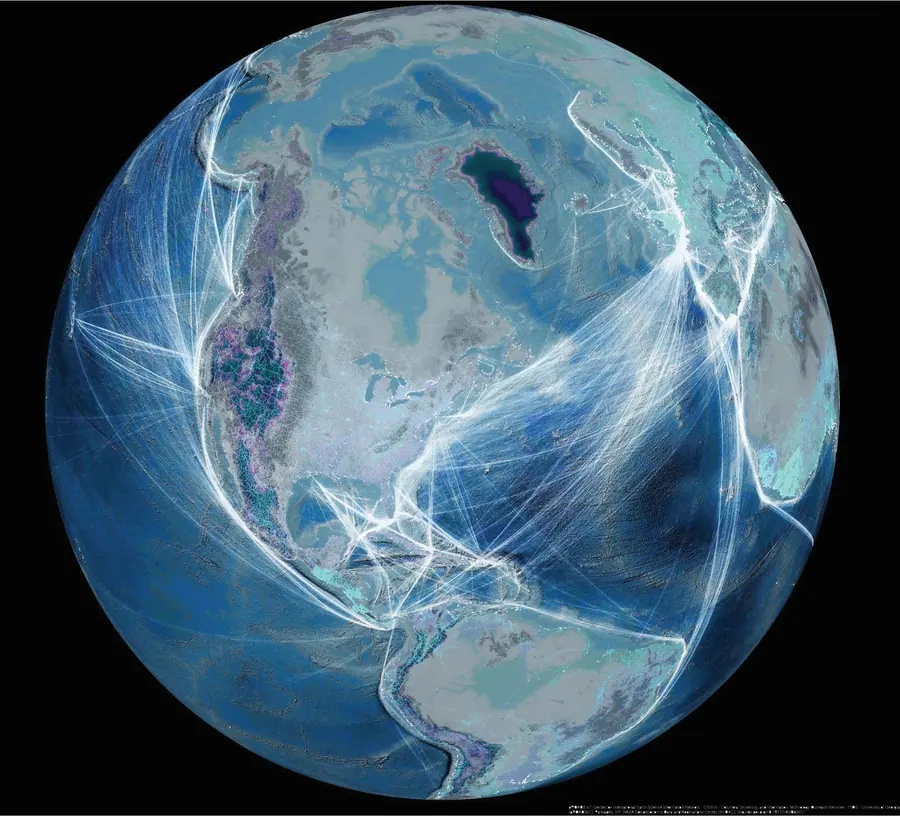 S.02TerritoryThe watershed as the unit of design. Case study: the Colorado River Basin, made at Metabolic Studio with Lauren Bon; 250,000 square miles supplying 40 million people.
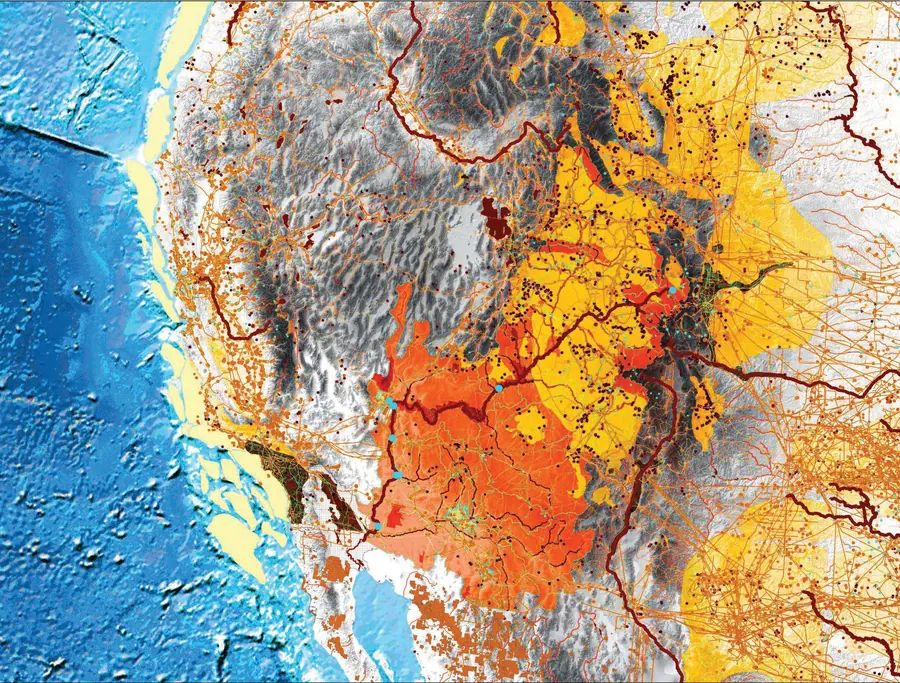 S.03CityPlatform cartography and digital twins: parcels, zoning, heat, canopy and community action in one model.
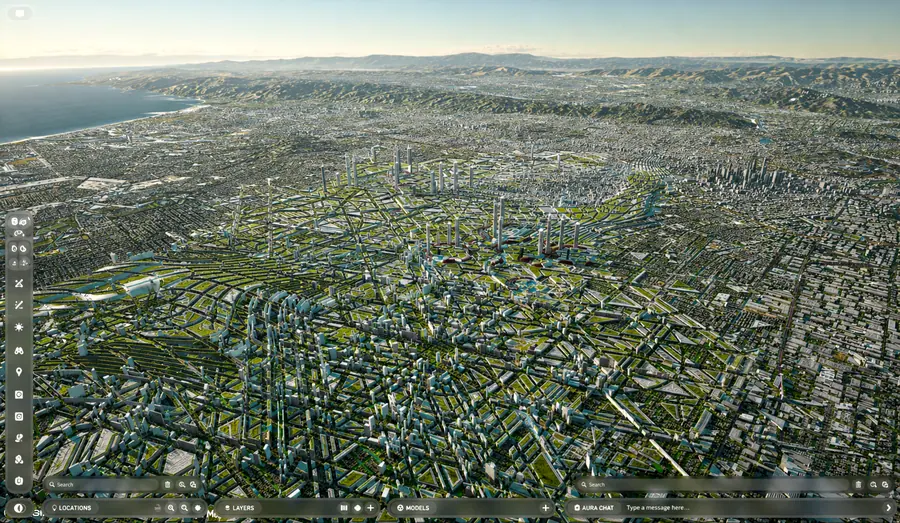 S.04BuildingThe building as an instrument for describing and foretelling the Earth: A.T.L.A.S. and the Instrument of Terrestrial Transformation.
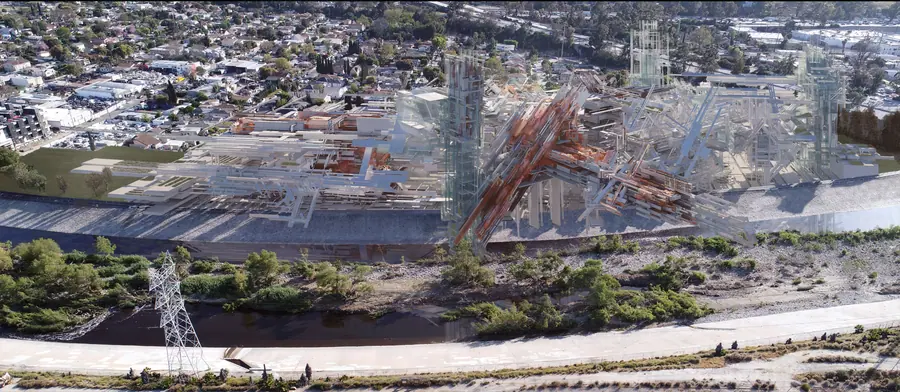 S.05MegastructureConstructed terrain: megaliths from mathematics, cities grown from one rule, and Project Genesis 001.
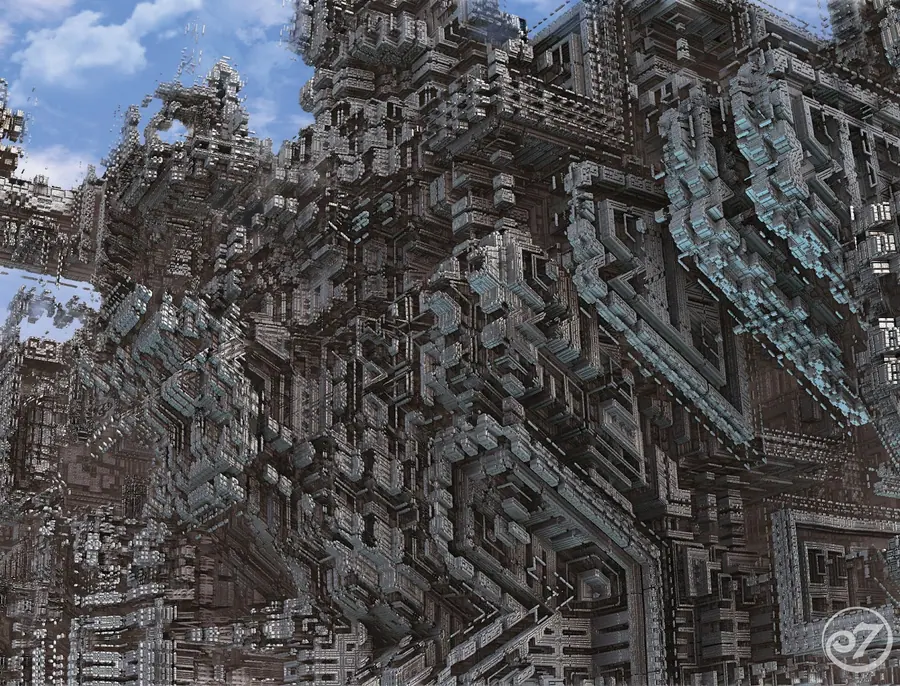
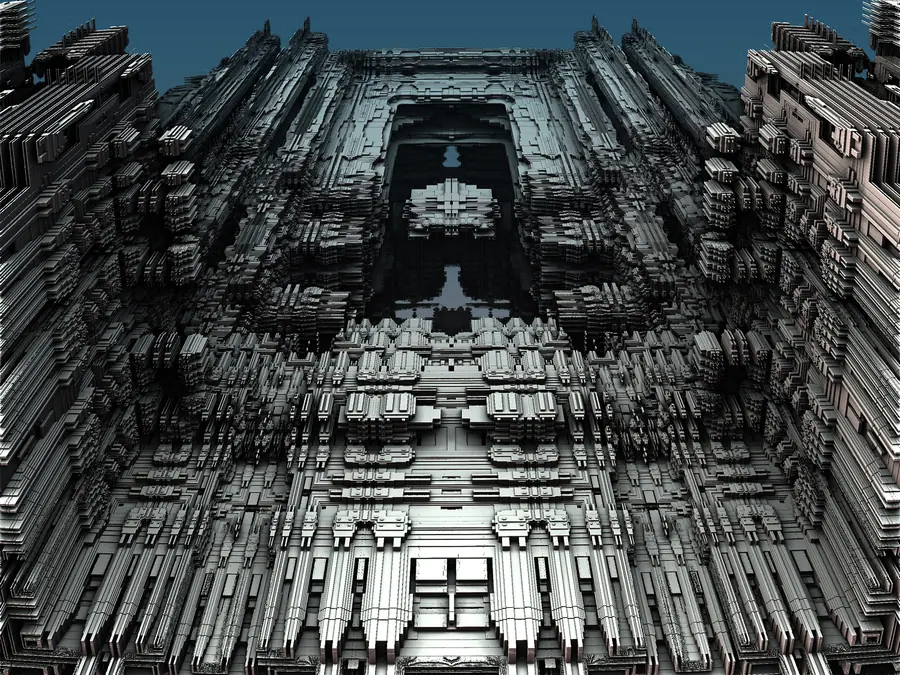 S.06GeometryFractal megastructure, harmonic grids and crystallographic tectonics: the rule systems that give form to all of the above.
Heaven on Earth, in practice.
Symbiosis is a discipline. These are the eight commitments by which the practice works toward a built world that belongs to the living one. Each is drawn from the two volumes of research.
- Dwell within the systems that sustain you.A project is drawn inside its watershed, its climate and its supply of matter and energy. The boundary of design is the boundary of the system, not of the lot.I, 10–11, 123
- Let form do the work of energy.In a forest, structure is how light and water are shared. Buildings and cities are shaped the same way: by sun, air, water and movement, so that form itself is the environmental system.I, 39–50
- Build with nature’s geometries, not against them.Branching, terracing, nesting and recursion are how the living world organises itself at every scale. They are taken as the grammar of construction.II, 164
- Make structure an armature for life.Terraces, courts and voids are made as ground for soil, water and habitat. The built mass carries natural systems and lets them grow upon it.I, 136
- Listen before acting.The land is sensed, described and modelled before it is touched, and sensed again afterwards. "The Earth does not need saving by intelligence. It needs intelligence capable of listening."II, 198
- Tune; do not command.Intervention works with the tendencies already present in a place, in small corrections that settle, instead of forcing an outcome on it.II, 195
- Keep what you are given.Architecture is answerable to human and non-human life alike. The old instruction is to till and to keep: to cultivate and to protect in the same act.I, 15–22
- Seek coherence, and beauty follows.Beauty is not applied. It is what a place looks like when its parts, built and living, belong to one another.II, 198
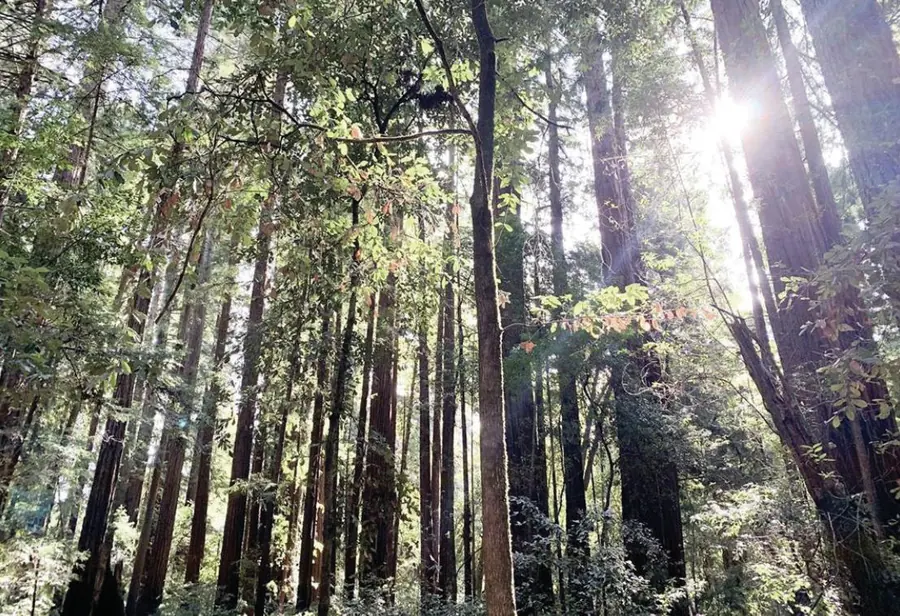
Architecture is the continuation of cosmic law into cultural form.
Vol. II: The Codex, p. 137
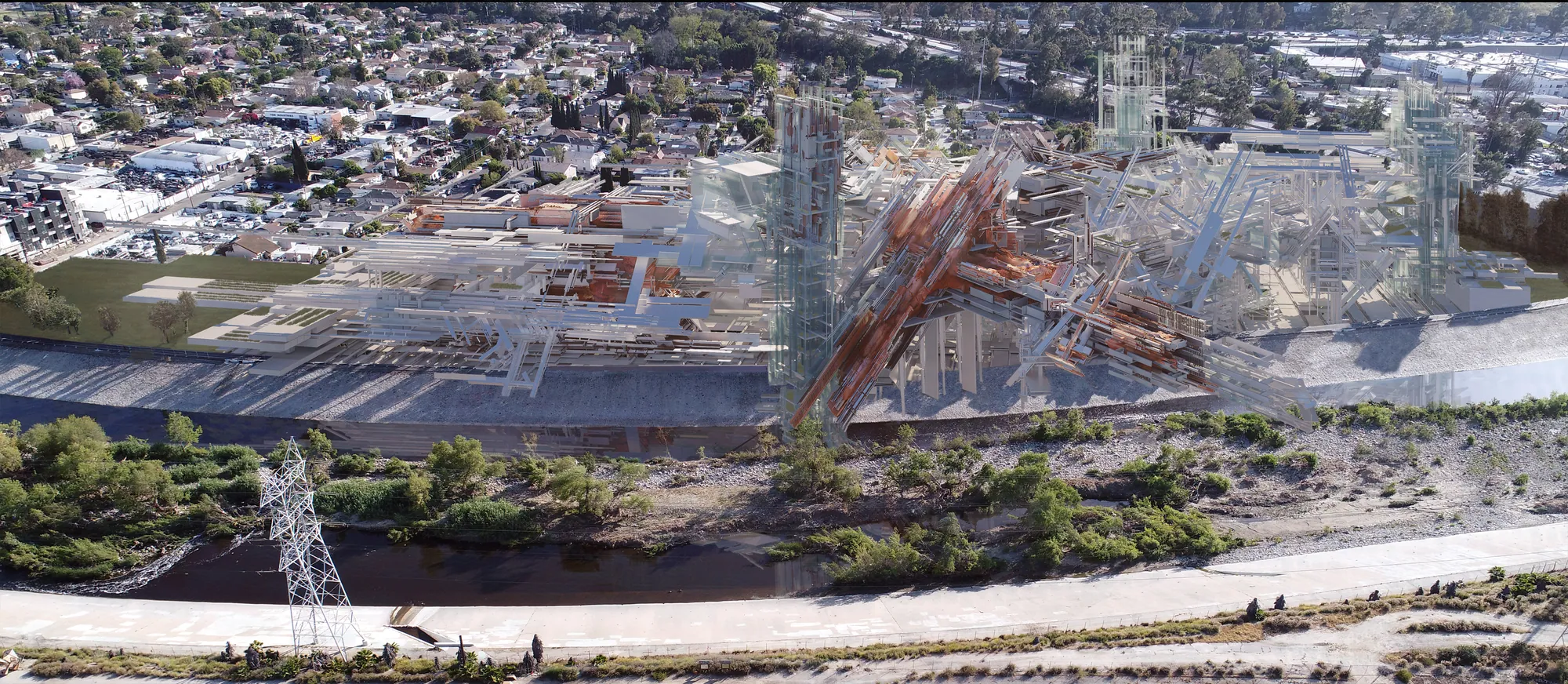
Buildings that read the Earth.
A.T.L.A.S. on the Los Angeles River
Speculative · SCI-Arc thesis · Vol. I, p. 131
Two volumes of research.
The practice is founded on two books by Jack Oliva-Rendler, published by e7 Architecture Studio Press and available on Amazon. They are the definitive statement of the position summarised on this site.
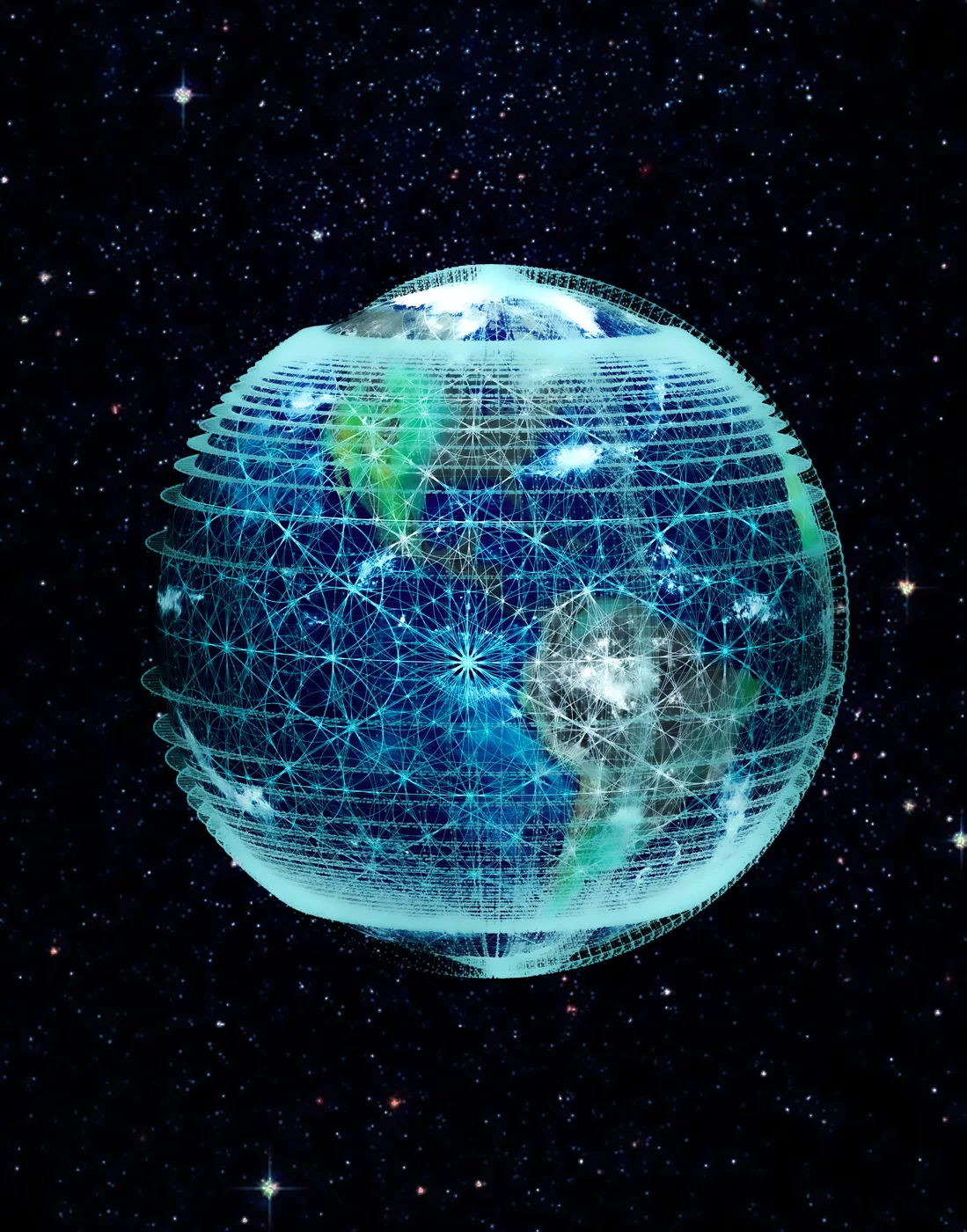
Terrestrial Architecture
Environmental design and large-scale architecture through geometry, geospatial modelling and philosophy. Three parts: natural systems, computation, morphology.
Contents and detail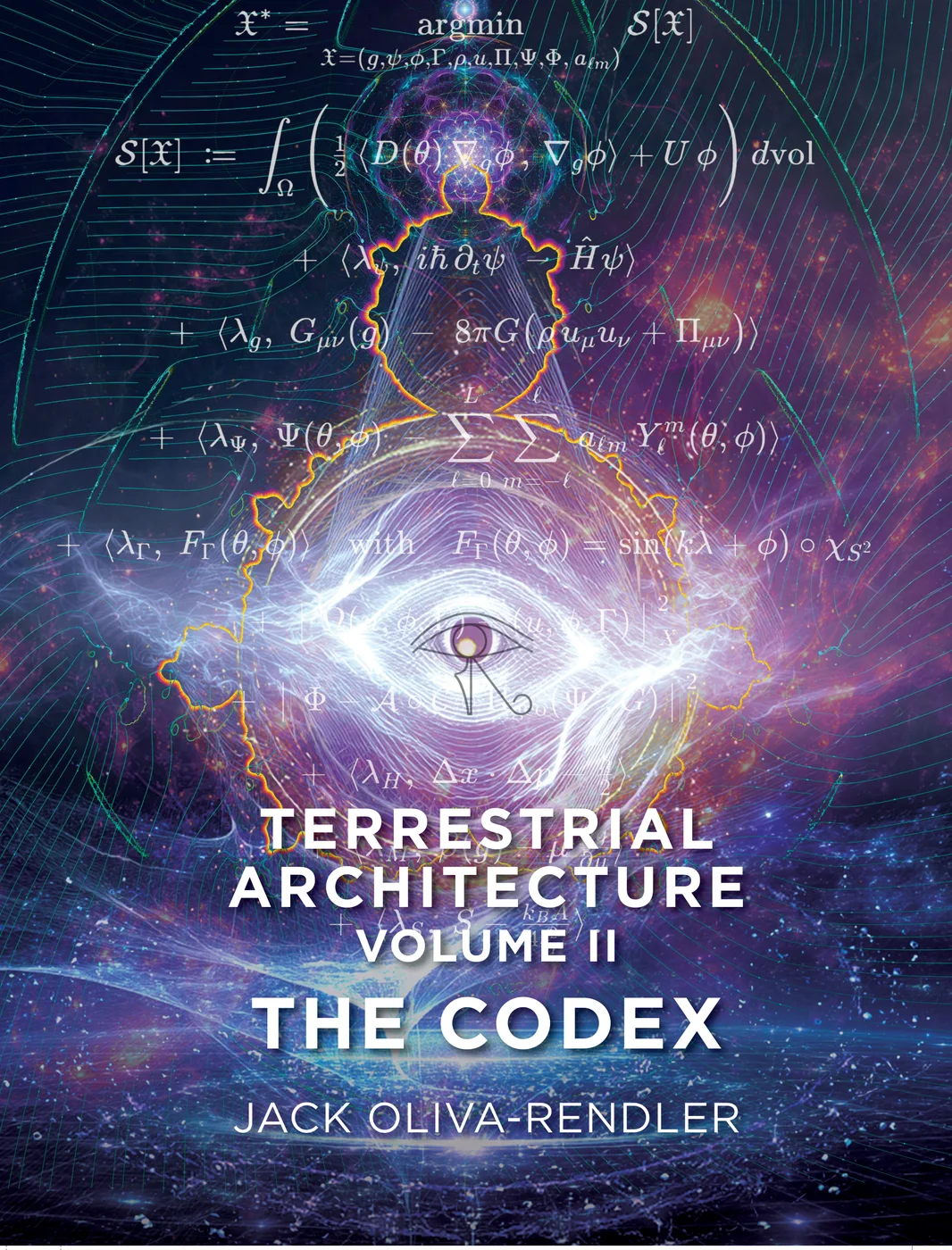
The Codex
Twenty-five chapters that move from tensor fields and spherical harmonics to crystalline megastructures, the AURA platform and autonomous ecological restoration.
Contents and detailRead the CodexWho is behind it.
ATLAS TERRAFORMA was founded by Jack Oliva-Rendler, designer, researcher and author of Terrestrial Architecture, Volumes I and II. He grew up between two architects, Michael Rendler and Marcela Oliva, in a household where geometry, structure and the built environment were daily conversation, and came to architecture through a question that has stayed with him: how the places we make shape us, and how they might be made in harmony with the natural systems of the Earth.
He studied at the Southern California Institute of Architecture, where his thesis A.T.L.A.S. was awarded the undergraduate thesis prize, and received his Master of Architecture from the Harvard Graduate School of Design. Both theses proposed new architectures for observing, understanding and caring for the planet.
He is a director of e7 Architecture Studio alongside his father. He worked at Metabolic Studio in Los Angeles under the artist Lauren Bon, where the Colorado River Basin research was produced, and gained experience at MAD Architects in Beijing, Morphosis and Gensler. He teaches algorithmic fractal modelling through Futurly, and his urban design work has been recognised by Mars City Design.
The name of the practice holds its purpose. ATLAS is the Earth understood as one connected whole, and the title of the first instrument building, A.T.L.A.S. TERRAFORMA is the careful forming of environments in partnership with the land. Volume I describes that work as:
…an ever-expanding capacity to touch the Earth in a rippling gesture of terraformation.
Terrestrial Architecture, Vol. I, pp. 82–83
- Fields of work
- Planetary and territorial cartography; ecological urbanism; instrument buildings; megastructure; computational geometry
- Tools named in the books
- GIS, remote sensing, digital twins, Mandelbulb 3D, Unreal Engine, hand drawing
- Biographical sources
- Terrestrial Architecture, Vol. I, pp. 9, 78, 106, 198–202
“This book opens whole new terrains of algorithmic design for sustainability grounded in complex geospatial and metabolic contexts.”
Dr. Stuart CowanCo-author, Ecological Design; Executive Director, Buckminster Fuller Institute
“With beautiful prose and images, Jack Oliva-Rendler restores a spiritual dimension to architecture that has long been absent from most intellectual fields.”
Graham HarmanDistinguished Professor of Philosophy, SCI-Arc
“It’s a compelling read that challenges us to rethink our relationship with our planet through the lens of architecture in all its dimensions and fractals.”
Martin E. WainsteinFounder, Open Earth Foundation