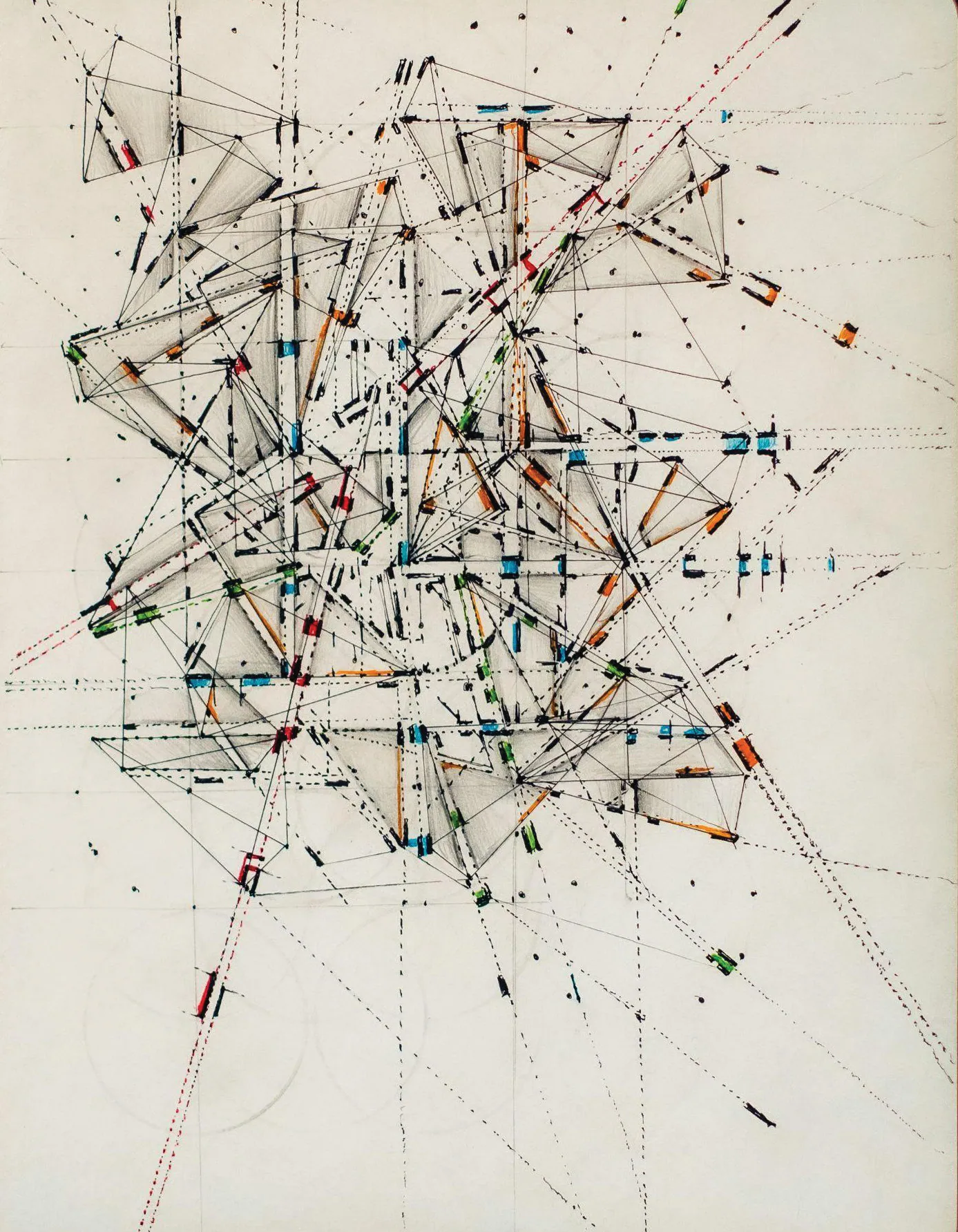
01 / Volume I
Terms of the first volume.
Definitions are given in the author’s words wherever the book supplies them. References are to volume and page.
| Term | Definition | Ref. |
|---|---|---|
| Terrestrial Architecture | The built environment’s "morphological formulation" continuously checked against the whole natural system, "instead of being an unpredictable amassing of sprawls." | I, 53 |
| A.T.L.A.S. | Apparatus for Technical Logic in Analytic Structures. "A platform architecture for Earth Analysis and Stewardship… a spatialized infrastructure of information." | I, 129 |
| Instrument of Terrestrial Transformation | A building as "an instrument, a device for modeling", holding libraries of description of the Earth as the basis for projecting its futures. | I, 135 |
| Megastructure | "A combination of many objects and systems… The ultimate megastructure being the earth as a whole." (Glen Howard Small) | I, 23, 136 |
| Algorithmic morphologies | "The language that Earth speaks in its physiognomy in chemistry and biology as architectures." | I, 49–50 |
| Fractal Architecture | Architecture that answers "a different model of societal needs, which is more holistic" through recursive rule systems. | I, 58 |
| Fractal city | "Continuously subdivided cellular systems… each building is an individual expression of the overall formula of the city." | I, 63 |
| Possibility space | "A set of possible futures defined by the properties of that object and… its surroundings." "Fields of energy are possibility spaces." | I, 51, 54 |
| Entelechy | "The realization of potential." | I, 52 |
| Interpolation | Computation as "the deriving of a curve, implied by a set of points in space." | I, 85 |
| Platform | "An interface or a managerial device that allows for the composition and decomposition of data." | I, 103 |
| VCAP | Virtual Community Action Planning: "a dynamic and innovative process that combines the deconstruction of a city with the integration of the Digital Gaia API." | I, 106 |
| Instrumentalization | "The encounter between the community and professionals with the platform." | I, 118 |
| Deep Storage | Library or memory storage reached by robotic retrieval, whose moving shelf-walls make new enclosures. | I, 141 |
| Harmonic grid | "Formed by inscribing tetrahedral geometries in tangential circles that are arrayed in the x and y axis." | I, 165 |
| Prototypical abstract geometry | Geometry as "a prescribed solution" for organising data and biospheric energy; the phrase is Michael Hays’s, from the thesis review. | I, 155–160 |
| Meta-morphology | A transformation "of increased scale and duration" revealed through cartographies. | I, 187 |
| Morphological epigenesis | "A manipulation of material and geometry." | I, 186 |
| Terraformation | The architect’s toolkit as "an ever-expanding capacity to touch the Earth in a rippling gesture of terraformation." | I, 82–83 |
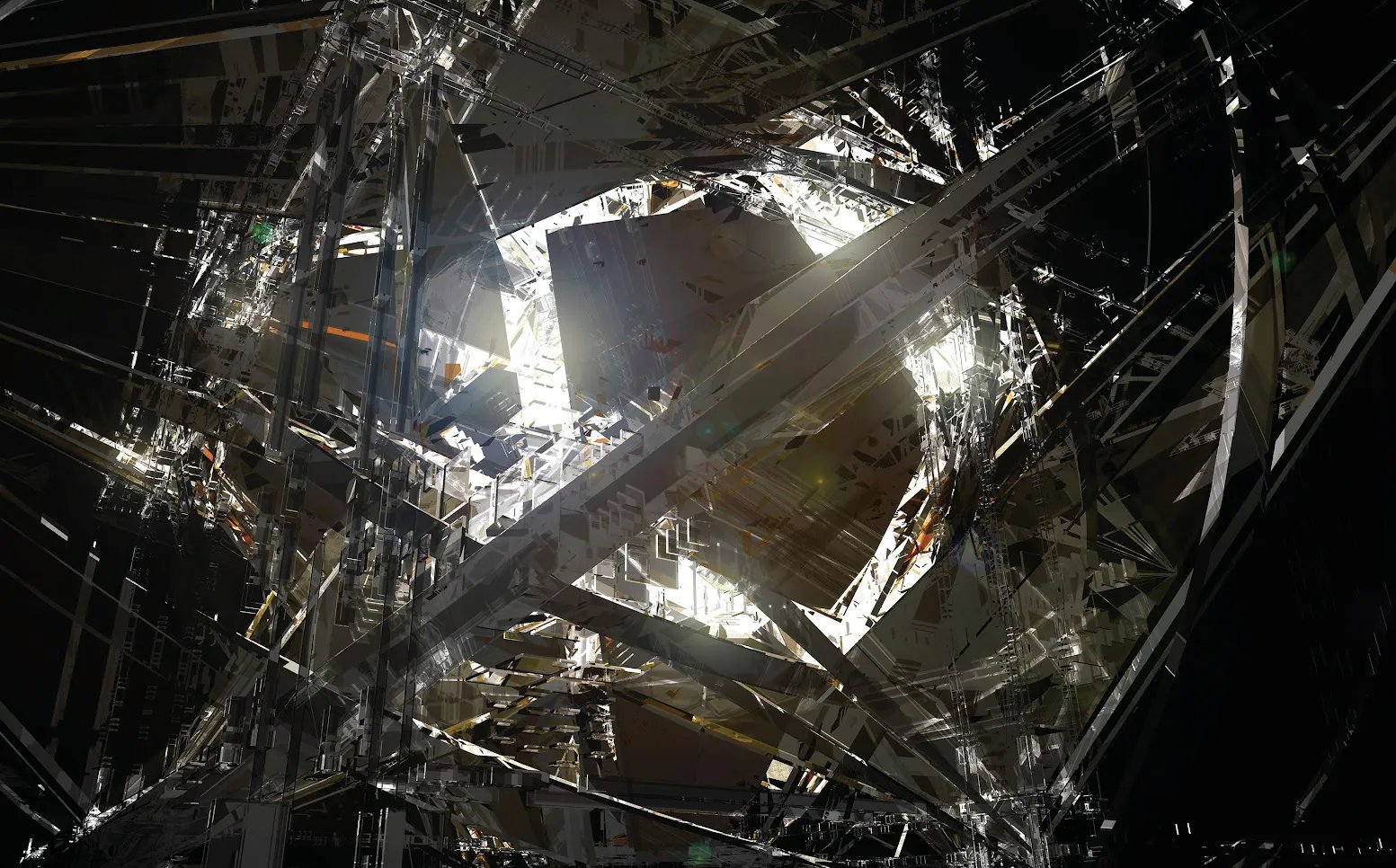
A vocabulary.
Crystalline tectonic structure
Terrestrial Architecture, Vol. I, p. 179
02 / Volume II
Terms of the Codex.
| Term | Definition | Ref. |
|---|---|---|
| Contraction operator | A mapping that brings states closer together at each application and so converges on a fixed point. Architecture is described as one. | II, 19–25, 137–139 |
| Nonviolent attractor | The equilibrium reached by contraction and not by force. | II, 33, 41 |
| Paradiso condition | "Paradisiacal equilibrium—stability without coercion." | II, 25 |
| The Armada | A harmonic lattice around the Earth, "not made of ships or soldiers but of harmony itself"; formally, a multidimensional vector field. | II, 17, 33 |
| Tensorial emptiness | The void as loom. Reality = Void + Tensorial Relations. | II, 71–75 |
| Tensorial monism | Mind and matter as aspects of one manifold. | II, 52 |
| Planetary Tensor Grid | The Earth as a spherical standing wave whose nodes the book associates with sacred sites. | II, 77–80 |
| Fractal synaptogenesis | Connection as a universal geometry: "synapses… are universal, a geometry of interconnection." | II, 155–156 |
| Crystalline megastructure | The "contraction of planetary harmonic fabric into human form." | II, 137–140 |
| Architecture of Ascension | Architecture as "cosmological operator"; ascension "not as escape, but as alignment." | II, 11, 143 |
| Quantum Atlas / Band Plate | Libraries of standing-wave patterns read as plans and routes. | II, 116–122 |
| Super-Formula | The unified variational functional that closes the geometrical thesis. | II, 150, 159 |
| AURA | A "geospatial and extended reality (XR) platform" applying the Codex to live data. | II, 161 |
| Codex Swarm | A "constellation of specialized autonomous agents" for ecological restoration. | II, 196 |
| Codex Tuning | The convergence discipline governing those agents. | II, 196 |
| Omega | After Teilhard de Chardin: an attractor, "an architecture of approach rather than arrival." | II, 186–187 |
| Noospheric architecture | A proposal for "planetary scale interiors." | II, 190 |
03 / Register
Register of works.
Every project and study shown on this site, with its status. Speculative means unbuilt design research.
| Work | Type | Site | Status | Where |
|---|---|---|---|---|
| A.T.L.A.S. | Instrument building | Los Angeles River | Speculative · SCI-Arc thesis | Instruments 02 |
| Instrument of Terrestrial Transformation | Instrument building | Forests near San Francisco | Speculative · Harvard GSD thesis | Instruments 03 |
| Deep Storage | Robotic library study | — | Speculative | Instruments 04 |
| Eco-Lab | Interior landscape | — | Study | Instruments 05 |
| Colorado River Basin | Territorial cartography | Colorado River Basin | Research · Lauren Bon and Metabolic Studio | Territory 03 |
| Global trade cartography | Planetary cartography | Global | Research · Lauren Bon and Metabolic Studio | Territory 01 |
| Virtual Community Action Planning | Platform and curriculum | Watts, Los Angeles | Proposal · e7 Architecture Studio | Territory 04 |
| AURA | Geospatial and XR platform | Multiple cities | Platform | Territory 05 |
| Codex Swarm | Restoration agents | — | Proposal | Territory 06 |
| Fractal megastructure | Generated urban field | — | Speculative | Megastructure 03 |
| Megalith studies | Generated monumental space | — | Speculative | Megastructure 02 |
| Exodus | Megastructure in landscape | Mountain valley | Study | Megastructure 04 |
| Helios Arc | Spanning structure | Canyon | Study | Megastructure 04 |
| Radial city | Prototypical cartography | — | Speculative | Morphology 04 |
| Project Genesis 001 | Temple megastructure | To be published | In design | Megastructure 07 |
04 / Lineage
Sources and precedents.
The thinkers and works the two books lean on most heavily, and what each contributes.
| Name | Work | Contribution |
|---|---|---|
| Vladimir Vernadsky | The Biosphere; Geochemistry and the Biosphere | The biosphere as a transformer of cosmic energy; elemental cycles; form over substance. |
| James Lovelock | Gaia | The Earth as a self-regulating cybernetic system. |
| Glen Howard Small | Biomorphic Biosphere, 1969–1973 | The megastructure defined as ecological whole; the founding precedent. |
| Pope Francis | Laudato Si’ | The moral frame: care for a common home. |
| Norbert Wiener | Cybernetics | Feedback, prediction as interpolation, memory. |
| Buckminster Fuller · Konrad Wachsmann | Space frames, synergetics | Structure as canopy; comprehensive design. |
| Douglas Hofstadter | Gödel, Escher, Bach | Recursion, the strange loop, push and pop. |
| Graham Harman · Timothy Morton | Object-oriented ontology; hyperobjects | Objects that exceed their relations; things too large to see whole. |
| Bruno Latour | Facing Gaia | The end of the nature/culture divide. |
| Rupert Sheldrake · Greg Lynn | Morphic resonance; Animate Form | Form as field and as possibility space. |
| Benjamin Bratton | The Stack | Platforms as a new kind of sovereignty and architecture. |
| Sigfried Giedion | Mechanization Takes Command | The mechanism, the lock, the anonymous history of things. |
| Peter Eisenman · Zaha Hadid · Sol LeWitt | Procedural drawing | Rule and intuition in the making of form. |
| Lauren Bon · Metabolic Studio | Colorado River Basin research | Direction of the territorial cartography shown on this site. |
| Pierre Teilhard de Chardin | The Phenomenon of Man | Noosphere, complexification, Omega. |
| Peter Sloterdijk | Spheres | Interiors, immunology, the planetary inside. |
| Erwin Schrödinger · Albert Einstein | Wave mechanics; the 1905 papers | The physics the Codex reads for form. |
| Stefan Banach · John Hutchinson · Benoit Mandelbrot | Fixed points; iterated function systems; fractals | The mathematics of convergence and self-similarity. |
Mathematics is the mother of all sciences.
Terrestrial Architecture, Vol. I, p. 58
05 / Propositions
Twenty sentences.
The position of the practice in the words of the books.
- Our environments affect us.I, 9
- A greater totality of the built environment exists beyond a single parcel.I, 10
- Our landscapes are now canvases and our cities more manipulable than ever.I, 11
- As the human environment and the natural environment flourish together, the two also deteriorate as one.I, 20
- We are not autonomous beings, but embedded in a constellation of others with whom we share the planet.I, 22
- Perhaps nature is a technology.I, 41
- There is an architecture to organisms and an architecture to environments and a feedback loop between the two.I, 42
- We are destined for harmonic synergetic integration in the unified functioning of earth systems.I, 47
- Fields of energy are possibility spaces.I, 54
- Architecture can no longer serve the motives of finance and public and private power alone.I, 58
- Fractal construction is more a heuristic thought process than a technical procedure.I, 75
- The Earth is a continuous ecology that circumscribes the planet with interdependencies networked in its totality.I, 123
- The building as an instrument is an institutional foundation for a dialogue between the Earth and the Design Disciplines.I, 135
- The degree to which we can derive a sophisticated geometric system is our ability to bring harmony to our complex realities.I, 182
- Architecture is the continuation of cosmic law into cultural form.II, 137
- Geometry is resonance rendered tangible.II, 138
- Build with nature’s geometries, not against them.II, 164
- The Earth is not broken.II, 195
- Beauty emerges not from ornament, but from coherence.II, 198
- The Earth does not need saving by intelligence. It needs intelligence capable of listening.II, 198